Thursday, August 31, 2006
Life's adventure continues...

Today my friend MorganRose drove up from Toledo, Ohio and we spent a lovely day together. She brought a scumptious picnic lunch which we ate at the dining room table because we got hungry before we'd made it down to the park. Afterwards we walk/scooted to the park. There was a clarity to the air you never see in the summer. The colors were so vivid they made you squint. MorganRose and I sat at a table on the screened porch in the community center while I read over a good-sized packet of her poems.
MorganRose is an exceptional poet and I've been encouraging her to gather her poems so we could see about getting them published, either in poetry journals or in a book. Today I began categorizing them according to subject matter. There wasn't a loser in the bunch. As I told MorganRose later, I felt like I'd been served a 17-course meal; her work is that rich.
In the midst of our work, I took time for a much needed lap swim. It had been a full week since I'd been in the pool and I was sorely missing it. After a nice long swim I came back and we finished our project for the day. After we'd gotten back home Eddie brought us Chinese take-out for dinner. Eddie seems to enjoy MorganRose as much as I. It's always fun when that happens.
I also want to talk about yesterday.
The Windsor Women In Black invited me to join them for their weekly peace vigil in front of the Ambassador Bridge. Following that, they wanted me to come to their weekly meeting and discuss my 18-day Lebanon Peace Initiative in Washington, DC.
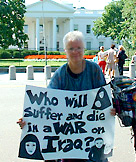
In preparation, I'd spent the last three days reading and editing my blog from that time. On Tuesday I took it to Kinko's to be printed as a spiral-bound notebook. On the cover I placed a picture of me holding up my sign in front of the White House, but that was the only photo I used. The 110 pages inside included my blog entries as well as a number of articles and/or interviews to which I'd posted links.
This was only the second time I've ever printed a portion of my blog in hard copy. I must admit it becomes more real when I hold it in my hands like this. And these particular entries--starting with my phone call to Sulaima two hours after Israel first bombed the Beirut International Airport on July 13, through my phone visit with the whole family in Kuwait on August 14, the day the ceasefire had finally gone into effect--were extremely powerful for me to relive.
Yesterday I started my presentation to the Windsor Women In Black by giving some background about how I'd become so close to Rabih, Sulaima and the kids, my visit with them in Lebanon last November, the reasons for my decision on July 19 to go to DC and mount a solitary vigil for the Lebanese people, and a brief synopsis of what had happened during those 18 days, especially the opportunities I'd had to engage in dialogues with people from around the world. I then asked if they had any questions or comments.
That began a lively discussion of the political and historical aspects of this current war between Israel and Hezbollah. It soon became obvious that one of the women held views that were not shared by the others. I found myself joining the others in trying to get her to change her mind. Suddenly I saw what was happening and said, "Wait! Are we trying to change one another's minds, or better understand what each person believes?"
That started a discussion about the use of dialogue and what purpose it can serve. Several of the women had to leave, so we only scratched the surface of this exploration into what I'm coming to see as the heart of my learnings during those 18 days: nonviolent dialogue. Fortunately, the woman whose views we'd tried to change was able to stay and she and I entered into a true dialogue. Just as I'd found in Washington, DC, if I asked the right questions and then listened closely to her answers, I came to a much better understanding not only of what she believed, but the life experiences that had given rise to her beliefs.
Before we left, the woman with whom I'd dialogued expressed interest in taking a workshop on nonviolent dialogue. The other two women who were still there said they'd be interested too. I offered to facilitate such a workshop whenever they wanted.
I now see how I can best bring my learnings from the most powerful 18 days of my life to the peace community at large. I'd like to facilitate workshops called "Nonviolent Dialogue for Activists." They would include a sharing of my experiences in Washington, the techniques for nonviolent dialogue that I'd used during that time, followed by experiential exercises to help the participants try it out for themselves.
If you recall, during those 18 days in front of the White House I heard too many well-intentioned peace activists get into arguments with people who responded negatively to their signs. Day by day my commitment to and use of nonviolent dialogue was tested, but I only grew stronger in my belief in its effectiveness. Even in the face of extreme hostility, my encounters never degenerated into arguments. Like persons I've known who have gone to Guatemala for three-week immersion courses in the Spanish language, this was my immersion course in the art of nonviolent dialogue.
Yes, I gave in yesterday to my old habit of trying to talk someone into seeing things like I see them, but at least I caught myself before it had gone too far. I'd really like to be part of showing others what I think is a most effective way to bring about change. And not just change in others, but change in myself.
Instead of adding to the cycle of violence, I want to add to the spiral of peace.
Wednesday, August 30, 2006
She did it!!!

This afternoon I got a phone call that put a smile on my face that is going to stay there for a long, long time. It was my dear friend Nan calling from Hannibal, Missouri to tell me the results from the battery of tests that had been run on her last week. These were to see how the six chemotherapy treatments had affected the stage 4 uterine cancer she'd been diagnosed with last April.
drumroll, please...
NAN IS CANCER-FREE!!!
When her doctor added that she was in remission, Nan gently corrected him. "I am not in remission, I'm cured!" Knowing Nan, if that's what she says, that is the truth of it.
As she has been doing for all the years I've known her--21 and counting--Nan modeled how to stay positive even in the face of a pretty horrendous situation. From the beginning she refused to allow any negative or fear-producing words to be spoken in her presence. And that included the doctor's words. No cancer stories, no obsessing over all that might go wrong, no negativity at all. She stayed focused on seeing herself healed and getting on with her life. The chemo didn't even wear her down. If she'd get a twinge of nausea, Nan would simply take one of her holistic tablets and it would go away. Yes, she'd be exhausted for a week after each treatmment, but she'd simply gear down and allow her body to recover its strength.
I also think a very important element in her healing was the loving support of her friends and family, especially Anne, the woman with whom she has lived during the past seven months. Anne fed her, drove her to doctors' appointments, took over putting out Nan's monthly Friends of Silence newsletter, and graciously hosted a never-ending parade of houseguests. I was among them, so I know what I'm talking about. Talk about a faithful friend!
So now Nan can get on with her life. And that includes two books she's in the middle of writing. She already has four published books--just go to amazon.com and type in "Nan Merrill" as author--one of which she was in the process of self-publishing just as she received the diagnosis of cancer in April. Here's info I've posted before, but it bears repeating:
Nan Merrill's "Peace Planet: Light for Our World", with reflections written (prayed over) by Nan and photographs chosen by Barbara Taylor for each country in the world. If you'd be interested in ordering this jewel of a book, send a check made out to Friends of Silence (US currency only) to FOS Peace and Prayer Gift Shop, 200 Rock Street, Hannibal, MO 63401. Enclose $15 for orders to be mailed within the US (shipping/handling is included). Email them at FriendsofSilence@sbcglobal.net for info regarding orders to be mailed outside the country, or for large volume orders.
May dear Nan live many more years and continue to show us how to be fearless lovers of life.
Tuesday, August 29, 2006
So now we know...
Once again investigative reporter Seymour Hersh has cast his line into the murky depths of Washington politics and caught the big fat scaly fish called Truth.
WATCHING LEBANON
by SEYMOUR M. HERSH
Washington's interests in Israel's war.
The New Yorker
Issue of 2006-08-21
Posted 2006-08-14
In the days after Hezbollah crossed from Lebanon into Israel, on July 12th, to kidnap two soldiers, triggering an Israeli air attack on Lebanon and a full-scale war, the Bush Administration seemed strangely passive. "It's a moment of clarification," President George W. Bush said at the G-8 summit, in St. Petersburg, on July 16th. "It's now become clear why we don't have peace in the Middle East." He described the relationship between Hezbollah and its supporters in Iran and Syria as one of the "root causes of instability," and subsequently said that it was up to those countries to end the crisis. Two days later, despite calls from several governments for the United States to take the lead in negotiations to end the fighting, Secretary of State Condoleezza Rice said that a ceasefire should be put off until "the conditions are conducive."
The Bush Administration, however, was closely involved in the planning of Israel's retaliatory attacks. President Bush and Vice-President Dick Cheney were convinced, current and former intelligence and diplomatic officials told me, that a successful Israeli Air Force bombing campaign against Hezbollah's heavily fortified underground-missile and command-and-control complexes in Lebanon could ease Israel's security concerns and also serve as a prelude to a potential American preemptive attack to destroy Iran's nuclear installations, some of which are also buried deep underground.
Israeli military and intelligence experts I spoke to emphasized that the country's immediate security issues were reason enough to confront Hezbollah, regardless of what the Bush Administration wanted. Shabtai Shavit, a national-security adviser to the Knesset who headed the Mossad, Israel's foreign-intelligence service, from 1989 to 1996, told me, "We do what we think is best for us, and if it happens to meet America's requirements, that's just part of a relationship between two friends. Hezbollah is armed to the teeth and trained in the most advanced technology of guerrilla warfare. It was just a matter of time. We had to address it."
Hezbollah is seen by Israelis as a profound threat--a terrorist organization, operating on their border, with a military arsenal that, with help from Iran and Syria, has grown stronger since the Israeli occupation of southern Lebanon ended, in 2000. Hezbollah's leader, Sheikh Hassan Nasrallah, has said he does not believe that Israel is a "legal state." Israeli intelligence estimated at the outset of the air war that Hezbollah had roughly five hundred medium-range Fajr-3 and Fajr-5 rockets and a few dozen long-range Zelzal rockets; the Zelzals, with a range of about two hundred kilometres, could reach Tel Aviv. (One rocket hit Haifa the day after the kidnappings.) It also has more than twelve thousand shorter-range rockets. Since the conflict began, more than three thousand of these have been fired at Israel.
According to a Middle East expert with knowledge of the current thinking of both the Israeli and the U.S. governments, Israel had devised a plan for attacking Hezbollah--and shared it with Bush Administration officials--well before the July 12th kidnappings. "It's not that the Israelis had a trap that Hezbollah walked into," he said, "but there was a strong feeling in the White House that sooner or later the Israelis were going to do it."
The Middle East expert said that the Administration had several reasons for supporting the Israeli bombing campaign. Within the State Department, it was seen as a way to strengthen the Lebanese government so that it could assert its authority over the south of the country, much of which is controlled by Hezbollah. He went on, "The White House was more focussed on stripping Hezbollah of its missiles, because, if there was to be a military option against Iran's nuclear facilities, it had to get rid of the weapons that Hezbollah could use in a potential retaliation at Israel. Bush wanted both. Bush was going after Iran, as part of the Axis of Evil, and its nuclear sites, and he was interested in going after Hezbollah as part of his interest in democratization, with Lebanon as one of the crown jewels of Middle East democracy."
Administration officials denied that they knew of Israel's plan for the air war. The White House did not respond to a detailed list of questions. In response to a separate request, a National Security Council spokesman said, "Prior to Hezbollah's attack on Israel, the Israeli government gave no official in Washington any reason to believe that Israel was planning to attack. Even after the July 12th attack, we did not know what the Israeli plans were." A Pentagon spokesman said, "The United States government remains committed to a diplomatic solution to the problem of Iran's clandestine nuclear weapons program," and denied the story, as did a State Department spokesman.
The United States and Israel have shared intelligence and enjoyed close military cooperation for decades, but early this spring, according to a former senior intelligence official, high-level planners from the U.S. Air Force--under pressure from the White House to develop a war plan for a decisive strike against Iran's nuclear facilities--began consulting with their counterparts in the Israeli Air Force.
"The big question for our Air Force was how to hit a series of hard targets in Iran successfully," the former senior intelligence official said. "Who is the closest ally of the U.S. Air Force in its planning? It's not Congo--it's Israel. Everybody knows that Iranian engineers have been advising Hezbollah on tunnels and underground gun emplacements. And so the Air Force went to the Israelis with some new tactics and said to them, 'Let’s concentrate on the bombing and share what we have on Iran and what you have on Lebanon.' " The discussions reached the Joint Chiefs of Staff and Secretary of Defense Donald Rumsfeld, he said.
"The Israelis told us it would be a cheap war with many benefits," a U.S. government consultant with close ties to Israel said. "Why oppose it? We'll be able to hunt down and bomb missiles, tunnels, and bunkers from the air. It would be a demo for Iran."
A Pentagon consultant said that the Bush White House "has been agitating for some time to find a reason for a preemptive blow against Hezbollah." He added, "It was our intent to have Hezbollah diminished, and now we have someone else doing it." (As this article went to press, the United Nations Security Council passed a ceasefire resolution, although it was unclear if it would change the situation on the ground.)
According to Richard Armitage, who served as Deputy Secretary of State in Bush's first term--and who, in 2002, said that Hezbollah "may be the A team of terrorists"--Israel's campaign in Lebanon, which has faced unexpected difficulties and widespread criticism, may, in the end, serve as a warning to the White House about Iran. "If the most dominant military force in the region--the Israel Defense Forces--can't pacify a country like Lebanon, with a population of four million, you should think carefully about taking that template to Iran, with strategic depth and a population of seventy million," Armitage said. "The only thing that the bombing has achieved so far is to unite the population against the Israelis."
*****
Several current and former officials involved in the Middle East told me that Israel viewed the soldiers' kidnapping as the opportune moment to begin its planned military campaign against Hezbollah. "Hezbollah, like clockwork, was instigating something small every month or two," the U.S. government consultant with ties to Israel said. Two weeks earlier, in late June, members of Hamas, the Palestinian group, had tunnelled under the barrier separating southern Gaza from Israel and captured an Israeli soldier. Hamas also had lobbed a series of rockets at Israeli towns near the border with Gaza. In response, Israel had initiated an extensive bombing campaign and reoccupied parts of Gaza.
The Pentagon consultant noted that there had also been cross-border incidents involving Israel and Hezbollah, in both directions, for some time. "They've been sniping at each other," he said. "Either side could have pointed to some incident and said 'We have to go to war with these guys'--because they were already at war."
David Siegel, the spokesman at the Israeli Embassy in Washington, said that the Israeli Air Force had not been seeking a reason to attack Hezbollah. "We did not plan the campaign. That decision was forced on us." There were ongoing alerts that Hezbollah "was pressing to go on the attack," Siegel said. "Hezbollah attacks every two or three months," but the kidnapping of the soldiers raised the stakes.
In interviews, several Israeli academics, journalists, and retired military and intelligence officers all made one point: they believed that the Israeli leadership, and not Washington, had decided that it would go to war with Hezbollah. Opinion polls showed that a broad spectrum of Israelis supported that choice. "The neocons in Washington may be happy, but Israel did not need to be pushed, because Israel has been wanting to get rid of Hezbollah," Yossi Melman, a journalist for the newspaper Ha'aretz, who has written several books about the Israeli intelligence community, said. "By provoking Israel, Hezbollah provided that opportunity."
"We were facing a dilemma," an Israeli official said. Prime Minister Ehud Olmert "had to decide whether to go for a local response, which we always do, or for a comprehensive response--to really take on Hezbollah once and for all." Olmert made his decision, the official said, only after a series of Israeli rescue efforts failed.
The U.S. government consultant with close ties to Israel told me, however, that, from Israel's perspective, the decision to take strong action had become inevitable weeks earlier, after the Israeli Army's signals intelligence group, known as Unit 8200, picked up bellicose intercepts in late spring and early summer, involving Hamas, Hezbollah, and Khaled Meshal, the Hamas leader now living in Damascus.
One intercept was of a meeting in late May of the Hamas political and military leadership, with Meshal participating by telephone. "Hamas believed the call from Damascus was scrambled, but Israel had broken the code," the consultant said. For almost a year before its victory in the Palestinian elections in January, Hamas had curtailed its terrorist activities. In the late May intercepted conversation, the consultant told me, the Hamas leadership said that "they got no benefit from it, and were losing standing among the Palestinian population." The conclusion, he said, was " 'Let's go back into the terror business and then try and wrestle concessions from the Israeli government.' " The consultant told me that the U.S. and Israel agreed that if the Hamas leadership did so, and if Nasrallah backed them up, there should be "a full-scale response." In the next several weeks, when Hamas began digging the tunnel into Israel, the consultant said, Unit 8200 "picked up signals intelligence involving Hamas, Syria, and Hezbollah, saying, in essence, that they wanted Hezbollah to 'warm up' the north.” In one intercept, the consultant said, Nasrallah referred to Olmert and Defense Minister Amir Peretz "as seeming to be weak," in comparison with the former Prime Ministers Ariel Sharon and Ehud Barak, who had extensive military experience, and said "he thought Israel would respond in a small-scale, local way, as they had in the past."
*****
Earlier this summer, before the Hezbollah kidnappings, the U.S. government consultant said, several Israeli officials visited Washington, separately, "to get a green light for the bombing operation and to find out how much the United States would bear." The consultant added, "Israel began with Cheney. It wanted to be sure that it had his support and the support of his office and the Middle East desk of the National Security Council." After that, "persuading Bush was never a problem, and Condi Rice was on board," the consultant said.
The initial plan, as outlined by the Israelis, called for a major bombing campaign in response to the next Hezbollah provocation, according to the Middle East expert with knowledge of U.S. and Israeli thinking. Israel believed that, by targeting Lebanon's infrastructure, including highways, fuel depots, and even the civilian runways at the main Beirut airport, it could persuade Lebanon's large Christian and Sunni populations to turn against Hezbollah, according to the former senior intelligence official. The airport, highways, and bridges, among other things, have been hit in the bombing campaign. The Israeli Air Force had flown almost nine thousand missions as of last week. (David Siegel, the Israeli spokesman, said that Israel had targeted only sites connected to Hezbollah; the bombing of bridges and roads was meant to prevent the transport of weapons.)
The Israeli plan, according to the former senior intelligence official, was "the mirror image of what the United States has been planning for Iran." (The initial U.S. Air Force proposals for an air attack to destroy Iran's nuclear capacity, which included the option of intense bombing of civilian infrastructure targets inside Iran, have been resisted by the top leadership of the Army, the Navy, and the Marine Corps, according to current and former officials. They argue that the Air Force plan will not work and will inevitably lead, as in the Israeli war with Hezbollah, to the insertion of troops on the ground.)
Uzi Arad, who served for more than two decades in the Mossad, told me that to the best of his knowledge the contacts between the Israeli and U.S. governments were routine, and that, "in all my meetings and conversations with government officials, never once did I hear anyone refer to prior coordination with the United States." He was troubled by one issue--the speed with which the Olmert government went to war. "For the life of me, I've never seen a decision to go to war taken so speedily," he said. "We usually go through long analyses."
The key military planner was Lieutenant General Dan Halutz, the I.D.F. chief of staff, who, during a career in the Israeli Air Force, worked on contingency planning for an air war with Iran. Olmert, a former mayor of Jerusalem, and Peretz, a former labor leader, could not match his experience and expertise.
In the early discussions with American officials, I was told by the Middle East expert and the government consultant, the Israelis repeatedly pointed to the war in Kosovo as an example of what Israel would try to achieve. The NATO forces commanded by U.S. Army General Wesley Clark methodically bombed and strafed not only military targets but tunnels, bridges, and roads, in Kosovo and elsewhere in Serbia, for seventy-eight days before forcing Serbian forces to withdraw from Kosovo. "Israel studied the Kosovo war as its role model," the government consultant said. "The Israelis told Condi Rice, 'You did it in about seventy days, but we need half of that--thirty-five days.' "
There are, of course, vast differences between Lebanon and Kosovo. Clark, who retired from the military in 2000 and unsuccessfully ran as a Democrat for the Presidency in 2004, took issue with the analogy: "If it's true that the Israeli campaign is based on the American approach in Kosovo, then it missed the point. Ours was to use force to obtain a diplomatic objective--it was not about killing people." Clark noted in a 2001 book, "Waging Modern War," that it was the threat of a possible ground invasion as well as the bombing that forced the Serbs to end the war. He told me, "In my experience, air campaigns have to be backed, ultimately, by the will and capability to finish the job on the ground."
Kosovo has been cited publicly by Israeli officials and journalists since the war began. On August 6th, Prime Minister Olmert, responding to European condemnation of the deaths of Lebanese civilians, said, "Where do they get the right to preach to Israel? European countries attacked Kosovo and killed ten thousand civilians. Ten thousand! And none of these countries had to suffer before that from a single rocket. I'm not saying it was wrong to intervene in Kosovo. But please: don't preach to us about the treatment of civilians." (Human Rights Watch estimated the number of civilians killed in the NATO bombing to be five hundred; the Yugoslav government put the number between twelve hundred and five thousand.)
Cheney's office supported the Israeli plan, as did Elliott Abrams, a deputy national-security adviser, according to several former and current officials. (A spokesman for the N.S.C. denied that Abrams had done so.) They believed that Israel should move quickly in its air war against Hezbollah. A former intelligence officer said, "We told Israel, 'Look, if you guys have to go, we're behind you all the way. But we think it should be sooner rather than later--the longer you wait, the less time we have to evaluate and plan for Iran before Bush gets out of office.' "
Cheney's point, the former senior intelligence official said, was "What if the Israelis execute their part of this first, and it's really successful? It'd be great. We can learn what to do in Iran by watching what the Israelis do in Lebanon."
The Pentagon consultant told me that intelligence about Hezbollah and Iran is being mishandled by the White House the same way intelligence had been when, in 2002 and early 2003, the Administration was making the case that Iraq had weapons of mass destruction. "The big complaint now in the intelligence community is that all of the important stuff is being sent directly to the top--at the insistence of the White House--and not being analyzed at all, or scarcely," he said. "It's an awful policy and violates all of the N.S.A.'s strictures, and if you complain about it you're out," he said. "Cheney had a strong hand in this."
The long-term Administration goal was to help set up a Sunni Arab coalition--including countries like Saudi Arabia, Jordan, and Egypt--that would join the United States and Europe to pressure the ruling Shiite mullahs in Iran. "But the thought behind that plan was that Israel would defeat Hezbollah, not lose to it," the consultant with close ties to Israel said. Some officials in Cheney's office and at the N.S.C. had become convinced, on the basis of private talks, that those nations would moderate their public criticism of Israel and blame Hezbollah for creating the crisis that led to war. Although they did so at first, they shifted their position in the wake of public protests in their countries about the Israeli bombing. The White House was clearly disappointed when, late last month, Prince Saud al-Faisal, the Saudi foreign minister, came to Washington and, at a meeting with Bush, called for the President to intervene immediately to end the war. The Washington Post reported that Washington had hoped to enlist moderate Arab states "in an effort to pressure Syria and Iran to rein in Hezbollah, but the Saudi move... seemed to cloud that initiative."
*****
The surprising strength of Hezbollah's resistance, and its continuing ability to fire rockets into northern Israel in the face of the constant Israeli bombing, the Middle East expert told me, "is a massive setback for those in the White House who want to use force in Iran. And those who argue that the bombing will create internal dissent and revolt in Iran are also set back."
Nonetheless, some officers serving with the Joint Chiefs of Staff remain deeply concerned that the Administration will have a far more positive assessment of the air campaign than they should, the former senior intelligence official said. "There is no way that Rumsfeld and Cheney will draw the right conclusion about this," he said. "When the smoke clears, they'll say it was a success, and they'll draw reinforcement for their plan to attack Iran."
In the White House, especially in the Vice-President's office, many officials believe that the military campaign against Hezbollah is working and should be carried forward. At the same time, the government consultant said, some policymakers in the Administration have concluded that the cost of the bombing to Lebanese society is too high. "They are telling Israel that it's time to wind down the attacks on infrastructure."
Similar divisions are emerging in Israel. David Siegel, the Israeli spokesman, said that his country's leadership believed, as of early August, that the air war had been successful, and had destroyed more than seventy per cent of Hezbollah's medium- and long-range-missile launching capacity. "The problem is short-range missiles, without launchers, that can be shot from civilian areas and homes," Siegel told me. "The only way to resolve this is ground operations--which is why Israel would be forced to expand ground operations if the latest round of diplomacy doesn't work." Last week, however, there was evidence that the Israeli government was troubled by the progress of the war. In an unusual move, Major General Moshe Kaplinsky, Halutz's deputy, was put in charge of the operation, supplanting Major General Udi Adam. The worry in Israel is that Nasrallah might escalate the crisis by firing missiles at Tel Aviv. "There is a big debate over how much damage Israel should inflict to prevent it," the consultant said. "If Nasrallah hits Tel Aviv, what should Israel do? Its goal is to deter more attacks by telling Nasrallah that it will destroy his country if he doesn't stop, and to remind the Arab world that Israel can set it back twenty years. We're no longer playing by the same rules."
A European intelligence officer told me, "The Israelis have been caught in a psychological trap. In earlier years, they had the belief that they could solve their problems with toughness. But now, with Islamic martyrdom, things have changed, and they need different answers. How do you scare people who love martyrdom?" The problem with trying to eliminate Hezbollah, the intelligence officer said, is the group's ties to the Shiite population in southern Lebanon, the Bekaa Valley, and Beirut's southern suburbs, where it operates schools, hospitals, a radio station, and various charities.
A high-level American military planner told me, "We have a lot of vulnerability in the region, and we've talked about some of the effects of an Iranian or Hezbollah attack on the Saudi regime and on the oil infrastructure." There is special concern inside the Pentagon, he added, about the oil-producing nations north of the Strait of Hormuz. "We have to anticipate the unintended consequences," he told me. "Will we be able to absorb a barrel of oil at one hundred dollars? There is this almost comical thinking that you can do it all from the air, even when you're up against an irregular enemy with a dug-in capability. You're not going to be successful unless you have a ground presence, but the political leadership never considers the worst case. These guys only want to hear the best case."
There is evidence that the Iranians were expecting the war against Hezbollah. Vali Nasr, an expert on Shiite Muslims and Iran, who is a fellow at the Council on Foreign Relations and also teaches at the Naval Postgraduate School, in Monterey, California, said, "Every negative American move against Hezbollah was seen by Iran as part of a larger campaign against it. And Iran began to prepare for the showdown by supplying more sophisticated weapons to Hezbollah--anti-ship and anti-tank missiles--and training its fighters in their use. And now Hezbollah is testing Iran's new weapons. Iran sees the Bush Administration as trying to marginalize its regional role, so it fomented trouble."
Nasr, an Iranian-American who recently published a study of the Sunni-Shiite divide, entitled "The Shia Revival," also said that the Iranian leadership believes that Washington's ultimate political goal is to get some international force to act as a buffer--to physically separate Syria and Lebanon in an effort to isolate and disarm Hezbollah, whose main supply route is through Syria. "Military action cannot bring about the desired political result," Nasr said. The popularity of Iran's President, Mahmoud Ahmadinejad, a virulent critic of Israel, is greatest in his own country. If the U.S. were to attack Iran's nuclear facilities, Nasr said, "you may end up turning Ahmadinejad into another Nasrallah--the rock star of the Arab street."
*****
Donald Rumsfeld, who is one of the Bush Administration's most outspoken, and powerful, officials, has said very little publicly about the crisis in Lebanon. His relative quiet, compared to his aggressive visibility in the run-up to the Iraq war, has prompted a debate in Washington about where he stands on the issue.
Some current and former intelligence officials who were interviewed for this article believe that Rumsfeld disagrees with Bush and Cheney about the American role in the war between Israel and Hezbollah. The U.S. government consultant with close ties to Israel said that "there was a feeling that Rumsfeld was jaded in his approach to the Israeli war." He added, "Air power and the use of a few Special Forces had worked in Afghanistan, and he tried to do it again in Iraq. It was the same idea, but it didn't work. He thought that Hezbollah was too dug in and the Israeli attack plan would not work, and the last thing he wanted was another war on his shift that would put the American forces in Iraq in greater jeopardy."
A Western diplomat said that he understood that Rumsfeld did not know all the intricacies of the war plan. "He is angry and worried about his troops" in Iraq, the diplomat said. Rumsfeld served in the White House during the last year of the war in Vietnam, from which American troops withdrew in 1975, "and he did not want to see something like this having an impact in Iraq." Rumsfeld's concern, the diplomat added, was that an expansion of the war into Iran could put the American troops in Iraq at greater risk of attacks by pro-Iranian Shiite militias.
At a Senate Armed Services Committee hearing on August 3rd, Rumsfeld was less than enthusiastic about the war's implications for the American troops in Iraq. Asked whether the Administration was mindful of the war's impact on Iraq, he testified that, in his meetings with Bush and Condoleezza Rice, "there is a sensitivity to the desire to not have our country or our interests or our forces put at greater risk as a result of what's taking place between Israel and Hezbollah.... There are a variety of risks that we face in that region, and it's a difficult and delicate situation."
The Pentagon consultant dismissed talk of a split at the top of the Administration, however, and said simply, "Rummy is on the team. He'd love to see Hezbollah degraded, but he also is a voice for less bombing and more innovative Israeli ground operations." The former senior intelligence official similarly depicted Rumsfeld as being "delighted that Israel is our stalking horse."
There are also questions about the status of Condoleezza Rice. Her initial support for the Israeli air war against Hezbollah has reportedly been tempered by dismay at the effects of the attacks on Lebanon. The Pentagon consultant said that in early August she began privately "agitating" inside the Administration for permission to begin direct diplomatic talks with Syria--so far, without much success. Last week, the Times reported that Rice had directed an Embassy official in Damascus to meet with the Syrian foreign minister, though the meeting apparently yielded no results. The Times also reported that Rice viewed herself as "trying to be not only a peacemaker abroad but also a mediator among contending parties" within the Administration. The article pointed to a divide between career diplomats in the State Department and "conservatives in the government," including Cheney and Abrams, "who were pushing for strong American support for Israel."
The Western diplomat told me his embassy believes that Abrams has emerged as a key policymaker on Iran, and on the current Hezbollah-Israeli crisis, and that Rice's role has been relatively diminished. Rice did not want to make her most recent diplomatic trip to the Middle East, the diplomat said. "She only wanted to go if she thought there was a real chance to get a ceasefire."
Bush's strongest supporter in Europe continues to be British Prime Minister Tony Blair, but many in Blair's own Foreign Office, as a former diplomat said, believe that he has "gone out on a particular limb on this"--especially by accepting Bush's refusal to seek an immediate and total ceasefire between Israel and Hezbollah. "Blair stands alone on this," the former diplomat said. "He knows he's a lame duck who's on the way out, but he buys it"--the Bush policy. "He drinks the White House Kool-Aid as much as anybody in Washington." The crisis will really start at the end of August, the diplomat added, "when the Iranians"--under a United Nations deadline to stop uranium enrichment--"will say no."
Even those who continue to support Israel's war against Hezbollah agree that it is failing to achieve one of its main goals--to rally the Lebanese against Hezbollah. "Strategic bombing has been a failed military concept for ninety years, and yet air forces all over the world keep on doing it," John Arquilla, a defense analyst at the Naval Postgraduate School, told me. Arquilla has been campaigning for more than a decade, with growing success, to change the way America fights terrorism. "The warfare of today is not mass on mass," he said. "You have to hunt like a network to defeat a network. Israel focussed on bombing against Hezbollah, and, when that did not work, it became more aggressive on the ground. The definition of insanity is continuing to do the same thing and expecting a different result."
WATCHING LEBANON
by SEYMOUR M. HERSH
Washington's interests in Israel's war.
The New Yorker
Issue of 2006-08-21
Posted 2006-08-14
In the days after Hezbollah crossed from Lebanon into Israel, on July 12th, to kidnap two soldiers, triggering an Israeli air attack on Lebanon and a full-scale war, the Bush Administration seemed strangely passive. "It's a moment of clarification," President George W. Bush said at the G-8 summit, in St. Petersburg, on July 16th. "It's now become clear why we don't have peace in the Middle East." He described the relationship between Hezbollah and its supporters in Iran and Syria as one of the "root causes of instability," and subsequently said that it was up to those countries to end the crisis. Two days later, despite calls from several governments for the United States to take the lead in negotiations to end the fighting, Secretary of State Condoleezza Rice said that a ceasefire should be put off until "the conditions are conducive."
The Bush Administration, however, was closely involved in the planning of Israel's retaliatory attacks. President Bush and Vice-President Dick Cheney were convinced, current and former intelligence and diplomatic officials told me, that a successful Israeli Air Force bombing campaign against Hezbollah's heavily fortified underground-missile and command-and-control complexes in Lebanon could ease Israel's security concerns and also serve as a prelude to a potential American preemptive attack to destroy Iran's nuclear installations, some of which are also buried deep underground.
Israeli military and intelligence experts I spoke to emphasized that the country's immediate security issues were reason enough to confront Hezbollah, regardless of what the Bush Administration wanted. Shabtai Shavit, a national-security adviser to the Knesset who headed the Mossad, Israel's foreign-intelligence service, from 1989 to 1996, told me, "We do what we think is best for us, and if it happens to meet America's requirements, that's just part of a relationship between two friends. Hezbollah is armed to the teeth and trained in the most advanced technology of guerrilla warfare. It was just a matter of time. We had to address it."
Hezbollah is seen by Israelis as a profound threat--a terrorist organization, operating on their border, with a military arsenal that, with help from Iran and Syria, has grown stronger since the Israeli occupation of southern Lebanon ended, in 2000. Hezbollah's leader, Sheikh Hassan Nasrallah, has said he does not believe that Israel is a "legal state." Israeli intelligence estimated at the outset of the air war that Hezbollah had roughly five hundred medium-range Fajr-3 and Fajr-5 rockets and a few dozen long-range Zelzal rockets; the Zelzals, with a range of about two hundred kilometres, could reach Tel Aviv. (One rocket hit Haifa the day after the kidnappings.) It also has more than twelve thousand shorter-range rockets. Since the conflict began, more than three thousand of these have been fired at Israel.
According to a Middle East expert with knowledge of the current thinking of both the Israeli and the U.S. governments, Israel had devised a plan for attacking Hezbollah--and shared it with Bush Administration officials--well before the July 12th kidnappings. "It's not that the Israelis had a trap that Hezbollah walked into," he said, "but there was a strong feeling in the White House that sooner or later the Israelis were going to do it."
The Middle East expert said that the Administration had several reasons for supporting the Israeli bombing campaign. Within the State Department, it was seen as a way to strengthen the Lebanese government so that it could assert its authority over the south of the country, much of which is controlled by Hezbollah. He went on, "The White House was more focussed on stripping Hezbollah of its missiles, because, if there was to be a military option against Iran's nuclear facilities, it had to get rid of the weapons that Hezbollah could use in a potential retaliation at Israel. Bush wanted both. Bush was going after Iran, as part of the Axis of Evil, and its nuclear sites, and he was interested in going after Hezbollah as part of his interest in democratization, with Lebanon as one of the crown jewels of Middle East democracy."
Administration officials denied that they knew of Israel's plan for the air war. The White House did not respond to a detailed list of questions. In response to a separate request, a National Security Council spokesman said, "Prior to Hezbollah's attack on Israel, the Israeli government gave no official in Washington any reason to believe that Israel was planning to attack. Even after the July 12th attack, we did not know what the Israeli plans were." A Pentagon spokesman said, "The United States government remains committed to a diplomatic solution to the problem of Iran's clandestine nuclear weapons program," and denied the story, as did a State Department spokesman.
The United States and Israel have shared intelligence and enjoyed close military cooperation for decades, but early this spring, according to a former senior intelligence official, high-level planners from the U.S. Air Force--under pressure from the White House to develop a war plan for a decisive strike against Iran's nuclear facilities--began consulting with their counterparts in the Israeli Air Force.
"The big question for our Air Force was how to hit a series of hard targets in Iran successfully," the former senior intelligence official said. "Who is the closest ally of the U.S. Air Force in its planning? It's not Congo--it's Israel. Everybody knows that Iranian engineers have been advising Hezbollah on tunnels and underground gun emplacements. And so the Air Force went to the Israelis with some new tactics and said to them, 'Let’s concentrate on the bombing and share what we have on Iran and what you have on Lebanon.' " The discussions reached the Joint Chiefs of Staff and Secretary of Defense Donald Rumsfeld, he said.
"The Israelis told us it would be a cheap war with many benefits," a U.S. government consultant with close ties to Israel said. "Why oppose it? We'll be able to hunt down and bomb missiles, tunnels, and bunkers from the air. It would be a demo for Iran."
A Pentagon consultant said that the Bush White House "has been agitating for some time to find a reason for a preemptive blow against Hezbollah." He added, "It was our intent to have Hezbollah diminished, and now we have someone else doing it." (As this article went to press, the United Nations Security Council passed a ceasefire resolution, although it was unclear if it would change the situation on the ground.)
According to Richard Armitage, who served as Deputy Secretary of State in Bush's first term--and who, in 2002, said that Hezbollah "may be the A team of terrorists"--Israel's campaign in Lebanon, which has faced unexpected difficulties and widespread criticism, may, in the end, serve as a warning to the White House about Iran. "If the most dominant military force in the region--the Israel Defense Forces--can't pacify a country like Lebanon, with a population of four million, you should think carefully about taking that template to Iran, with strategic depth and a population of seventy million," Armitage said. "The only thing that the bombing has achieved so far is to unite the population against the Israelis."
*****
Several current and former officials involved in the Middle East told me that Israel viewed the soldiers' kidnapping as the opportune moment to begin its planned military campaign against Hezbollah. "Hezbollah, like clockwork, was instigating something small every month or two," the U.S. government consultant with ties to Israel said. Two weeks earlier, in late June, members of Hamas, the Palestinian group, had tunnelled under the barrier separating southern Gaza from Israel and captured an Israeli soldier. Hamas also had lobbed a series of rockets at Israeli towns near the border with Gaza. In response, Israel had initiated an extensive bombing campaign and reoccupied parts of Gaza.
The Pentagon consultant noted that there had also been cross-border incidents involving Israel and Hezbollah, in both directions, for some time. "They've been sniping at each other," he said. "Either side could have pointed to some incident and said 'We have to go to war with these guys'--because they were already at war."
David Siegel, the spokesman at the Israeli Embassy in Washington, said that the Israeli Air Force had not been seeking a reason to attack Hezbollah. "We did not plan the campaign. That decision was forced on us." There were ongoing alerts that Hezbollah "was pressing to go on the attack," Siegel said. "Hezbollah attacks every two or three months," but the kidnapping of the soldiers raised the stakes.
In interviews, several Israeli academics, journalists, and retired military and intelligence officers all made one point: they believed that the Israeli leadership, and not Washington, had decided that it would go to war with Hezbollah. Opinion polls showed that a broad spectrum of Israelis supported that choice. "The neocons in Washington may be happy, but Israel did not need to be pushed, because Israel has been wanting to get rid of Hezbollah," Yossi Melman, a journalist for the newspaper Ha'aretz, who has written several books about the Israeli intelligence community, said. "By provoking Israel, Hezbollah provided that opportunity."
"We were facing a dilemma," an Israeli official said. Prime Minister Ehud Olmert "had to decide whether to go for a local response, which we always do, or for a comprehensive response--to really take on Hezbollah once and for all." Olmert made his decision, the official said, only after a series of Israeli rescue efforts failed.
The U.S. government consultant with close ties to Israel told me, however, that, from Israel's perspective, the decision to take strong action had become inevitable weeks earlier, after the Israeli Army's signals intelligence group, known as Unit 8200, picked up bellicose intercepts in late spring and early summer, involving Hamas, Hezbollah, and Khaled Meshal, the Hamas leader now living in Damascus.
One intercept was of a meeting in late May of the Hamas political and military leadership, with Meshal participating by telephone. "Hamas believed the call from Damascus was scrambled, but Israel had broken the code," the consultant said. For almost a year before its victory in the Palestinian elections in January, Hamas had curtailed its terrorist activities. In the late May intercepted conversation, the consultant told me, the Hamas leadership said that "they got no benefit from it, and were losing standing among the Palestinian population." The conclusion, he said, was " 'Let's go back into the terror business and then try and wrestle concessions from the Israeli government.' " The consultant told me that the U.S. and Israel agreed that if the Hamas leadership did so, and if Nasrallah backed them up, there should be "a full-scale response." In the next several weeks, when Hamas began digging the tunnel into Israel, the consultant said, Unit 8200 "picked up signals intelligence involving Hamas, Syria, and Hezbollah, saying, in essence, that they wanted Hezbollah to 'warm up' the north.” In one intercept, the consultant said, Nasrallah referred to Olmert and Defense Minister Amir Peretz "as seeming to be weak," in comparison with the former Prime Ministers Ariel Sharon and Ehud Barak, who had extensive military experience, and said "he thought Israel would respond in a small-scale, local way, as they had in the past."
*****
Earlier this summer, before the Hezbollah kidnappings, the U.S. government consultant said, several Israeli officials visited Washington, separately, "to get a green light for the bombing operation and to find out how much the United States would bear." The consultant added, "Israel began with Cheney. It wanted to be sure that it had his support and the support of his office and the Middle East desk of the National Security Council." After that, "persuading Bush was never a problem, and Condi Rice was on board," the consultant said.
The initial plan, as outlined by the Israelis, called for a major bombing campaign in response to the next Hezbollah provocation, according to the Middle East expert with knowledge of U.S. and Israeli thinking. Israel believed that, by targeting Lebanon's infrastructure, including highways, fuel depots, and even the civilian runways at the main Beirut airport, it could persuade Lebanon's large Christian and Sunni populations to turn against Hezbollah, according to the former senior intelligence official. The airport, highways, and bridges, among other things, have been hit in the bombing campaign. The Israeli Air Force had flown almost nine thousand missions as of last week. (David Siegel, the Israeli spokesman, said that Israel had targeted only sites connected to Hezbollah; the bombing of bridges and roads was meant to prevent the transport of weapons.)
The Israeli plan, according to the former senior intelligence official, was "the mirror image of what the United States has been planning for Iran." (The initial U.S. Air Force proposals for an air attack to destroy Iran's nuclear capacity, which included the option of intense bombing of civilian infrastructure targets inside Iran, have been resisted by the top leadership of the Army, the Navy, and the Marine Corps, according to current and former officials. They argue that the Air Force plan will not work and will inevitably lead, as in the Israeli war with Hezbollah, to the insertion of troops on the ground.)
Uzi Arad, who served for more than two decades in the Mossad, told me that to the best of his knowledge the contacts between the Israeli and U.S. governments were routine, and that, "in all my meetings and conversations with government officials, never once did I hear anyone refer to prior coordination with the United States." He was troubled by one issue--the speed with which the Olmert government went to war. "For the life of me, I've never seen a decision to go to war taken so speedily," he said. "We usually go through long analyses."
The key military planner was Lieutenant General Dan Halutz, the I.D.F. chief of staff, who, during a career in the Israeli Air Force, worked on contingency planning for an air war with Iran. Olmert, a former mayor of Jerusalem, and Peretz, a former labor leader, could not match his experience and expertise.
In the early discussions with American officials, I was told by the Middle East expert and the government consultant, the Israelis repeatedly pointed to the war in Kosovo as an example of what Israel would try to achieve. The NATO forces commanded by U.S. Army General Wesley Clark methodically bombed and strafed not only military targets but tunnels, bridges, and roads, in Kosovo and elsewhere in Serbia, for seventy-eight days before forcing Serbian forces to withdraw from Kosovo. "Israel studied the Kosovo war as its role model," the government consultant said. "The Israelis told Condi Rice, 'You did it in about seventy days, but we need half of that--thirty-five days.' "
There are, of course, vast differences between Lebanon and Kosovo. Clark, who retired from the military in 2000 and unsuccessfully ran as a Democrat for the Presidency in 2004, took issue with the analogy: "If it's true that the Israeli campaign is based on the American approach in Kosovo, then it missed the point. Ours was to use force to obtain a diplomatic objective--it was not about killing people." Clark noted in a 2001 book, "Waging Modern War," that it was the threat of a possible ground invasion as well as the bombing that forced the Serbs to end the war. He told me, "In my experience, air campaigns have to be backed, ultimately, by the will and capability to finish the job on the ground."
Kosovo has been cited publicly by Israeli officials and journalists since the war began. On August 6th, Prime Minister Olmert, responding to European condemnation of the deaths of Lebanese civilians, said, "Where do they get the right to preach to Israel? European countries attacked Kosovo and killed ten thousand civilians. Ten thousand! And none of these countries had to suffer before that from a single rocket. I'm not saying it was wrong to intervene in Kosovo. But please: don't preach to us about the treatment of civilians." (Human Rights Watch estimated the number of civilians killed in the NATO bombing to be five hundred; the Yugoslav government put the number between twelve hundred and five thousand.)
Cheney's office supported the Israeli plan, as did Elliott Abrams, a deputy national-security adviser, according to several former and current officials. (A spokesman for the N.S.C. denied that Abrams had done so.) They believed that Israel should move quickly in its air war against Hezbollah. A former intelligence officer said, "We told Israel, 'Look, if you guys have to go, we're behind you all the way. But we think it should be sooner rather than later--the longer you wait, the less time we have to evaluate and plan for Iran before Bush gets out of office.' "
Cheney's point, the former senior intelligence official said, was "What if the Israelis execute their part of this first, and it's really successful? It'd be great. We can learn what to do in Iran by watching what the Israelis do in Lebanon."
The Pentagon consultant told me that intelligence about Hezbollah and Iran is being mishandled by the White House the same way intelligence had been when, in 2002 and early 2003, the Administration was making the case that Iraq had weapons of mass destruction. "The big complaint now in the intelligence community is that all of the important stuff is being sent directly to the top--at the insistence of the White House--and not being analyzed at all, or scarcely," he said. "It's an awful policy and violates all of the N.S.A.'s strictures, and if you complain about it you're out," he said. "Cheney had a strong hand in this."
The long-term Administration goal was to help set up a Sunni Arab coalition--including countries like Saudi Arabia, Jordan, and Egypt--that would join the United States and Europe to pressure the ruling Shiite mullahs in Iran. "But the thought behind that plan was that Israel would defeat Hezbollah, not lose to it," the consultant with close ties to Israel said. Some officials in Cheney's office and at the N.S.C. had become convinced, on the basis of private talks, that those nations would moderate their public criticism of Israel and blame Hezbollah for creating the crisis that led to war. Although they did so at first, they shifted their position in the wake of public protests in their countries about the Israeli bombing. The White House was clearly disappointed when, late last month, Prince Saud al-Faisal, the Saudi foreign minister, came to Washington and, at a meeting with Bush, called for the President to intervene immediately to end the war. The Washington Post reported that Washington had hoped to enlist moderate Arab states "in an effort to pressure Syria and Iran to rein in Hezbollah, but the Saudi move... seemed to cloud that initiative."
*****
The surprising strength of Hezbollah's resistance, and its continuing ability to fire rockets into northern Israel in the face of the constant Israeli bombing, the Middle East expert told me, "is a massive setback for those in the White House who want to use force in Iran. And those who argue that the bombing will create internal dissent and revolt in Iran are also set back."
Nonetheless, some officers serving with the Joint Chiefs of Staff remain deeply concerned that the Administration will have a far more positive assessment of the air campaign than they should, the former senior intelligence official said. "There is no way that Rumsfeld and Cheney will draw the right conclusion about this," he said. "When the smoke clears, they'll say it was a success, and they'll draw reinforcement for their plan to attack Iran."
In the White House, especially in the Vice-President's office, many officials believe that the military campaign against Hezbollah is working and should be carried forward. At the same time, the government consultant said, some policymakers in the Administration have concluded that the cost of the bombing to Lebanese society is too high. "They are telling Israel that it's time to wind down the attacks on infrastructure."
Similar divisions are emerging in Israel. David Siegel, the Israeli spokesman, said that his country's leadership believed, as of early August, that the air war had been successful, and had destroyed more than seventy per cent of Hezbollah's medium- and long-range-missile launching capacity. "The problem is short-range missiles, without launchers, that can be shot from civilian areas and homes," Siegel told me. "The only way to resolve this is ground operations--which is why Israel would be forced to expand ground operations if the latest round of diplomacy doesn't work." Last week, however, there was evidence that the Israeli government was troubled by the progress of the war. In an unusual move, Major General Moshe Kaplinsky, Halutz's deputy, was put in charge of the operation, supplanting Major General Udi Adam. The worry in Israel is that Nasrallah might escalate the crisis by firing missiles at Tel Aviv. "There is a big debate over how much damage Israel should inflict to prevent it," the consultant said. "If Nasrallah hits Tel Aviv, what should Israel do? Its goal is to deter more attacks by telling Nasrallah that it will destroy his country if he doesn't stop, and to remind the Arab world that Israel can set it back twenty years. We're no longer playing by the same rules."
A European intelligence officer told me, "The Israelis have been caught in a psychological trap. In earlier years, they had the belief that they could solve their problems with toughness. But now, with Islamic martyrdom, things have changed, and they need different answers. How do you scare people who love martyrdom?" The problem with trying to eliminate Hezbollah, the intelligence officer said, is the group's ties to the Shiite population in southern Lebanon, the Bekaa Valley, and Beirut's southern suburbs, where it operates schools, hospitals, a radio station, and various charities.
A high-level American military planner told me, "We have a lot of vulnerability in the region, and we've talked about some of the effects of an Iranian or Hezbollah attack on the Saudi regime and on the oil infrastructure." There is special concern inside the Pentagon, he added, about the oil-producing nations north of the Strait of Hormuz. "We have to anticipate the unintended consequences," he told me. "Will we be able to absorb a barrel of oil at one hundred dollars? There is this almost comical thinking that you can do it all from the air, even when you're up against an irregular enemy with a dug-in capability. You're not going to be successful unless you have a ground presence, but the political leadership never considers the worst case. These guys only want to hear the best case."
There is evidence that the Iranians were expecting the war against Hezbollah. Vali Nasr, an expert on Shiite Muslims and Iran, who is a fellow at the Council on Foreign Relations and also teaches at the Naval Postgraduate School, in Monterey, California, said, "Every negative American move against Hezbollah was seen by Iran as part of a larger campaign against it. And Iran began to prepare for the showdown by supplying more sophisticated weapons to Hezbollah--anti-ship and anti-tank missiles--and training its fighters in their use. And now Hezbollah is testing Iran's new weapons. Iran sees the Bush Administration as trying to marginalize its regional role, so it fomented trouble."
Nasr, an Iranian-American who recently published a study of the Sunni-Shiite divide, entitled "The Shia Revival," also said that the Iranian leadership believes that Washington's ultimate political goal is to get some international force to act as a buffer--to physically separate Syria and Lebanon in an effort to isolate and disarm Hezbollah, whose main supply route is through Syria. "Military action cannot bring about the desired political result," Nasr said. The popularity of Iran's President, Mahmoud Ahmadinejad, a virulent critic of Israel, is greatest in his own country. If the U.S. were to attack Iran's nuclear facilities, Nasr said, "you may end up turning Ahmadinejad into another Nasrallah--the rock star of the Arab street."
*****
Donald Rumsfeld, who is one of the Bush Administration's most outspoken, and powerful, officials, has said very little publicly about the crisis in Lebanon. His relative quiet, compared to his aggressive visibility in the run-up to the Iraq war, has prompted a debate in Washington about where he stands on the issue.
Some current and former intelligence officials who were interviewed for this article believe that Rumsfeld disagrees with Bush and Cheney about the American role in the war between Israel and Hezbollah. The U.S. government consultant with close ties to Israel said that "there was a feeling that Rumsfeld was jaded in his approach to the Israeli war." He added, "Air power and the use of a few Special Forces had worked in Afghanistan, and he tried to do it again in Iraq. It was the same idea, but it didn't work. He thought that Hezbollah was too dug in and the Israeli attack plan would not work, and the last thing he wanted was another war on his shift that would put the American forces in Iraq in greater jeopardy."
A Western diplomat said that he understood that Rumsfeld did not know all the intricacies of the war plan. "He is angry and worried about his troops" in Iraq, the diplomat said. Rumsfeld served in the White House during the last year of the war in Vietnam, from which American troops withdrew in 1975, "and he did not want to see something like this having an impact in Iraq." Rumsfeld's concern, the diplomat added, was that an expansion of the war into Iran could put the American troops in Iraq at greater risk of attacks by pro-Iranian Shiite militias.
At a Senate Armed Services Committee hearing on August 3rd, Rumsfeld was less than enthusiastic about the war's implications for the American troops in Iraq. Asked whether the Administration was mindful of the war's impact on Iraq, he testified that, in his meetings with Bush and Condoleezza Rice, "there is a sensitivity to the desire to not have our country or our interests or our forces put at greater risk as a result of what's taking place between Israel and Hezbollah.... There are a variety of risks that we face in that region, and it's a difficult and delicate situation."
The Pentagon consultant dismissed talk of a split at the top of the Administration, however, and said simply, "Rummy is on the team. He'd love to see Hezbollah degraded, but he also is a voice for less bombing and more innovative Israeli ground operations." The former senior intelligence official similarly depicted Rumsfeld as being "delighted that Israel is our stalking horse."
There are also questions about the status of Condoleezza Rice. Her initial support for the Israeli air war against Hezbollah has reportedly been tempered by dismay at the effects of the attacks on Lebanon. The Pentagon consultant said that in early August she began privately "agitating" inside the Administration for permission to begin direct diplomatic talks with Syria--so far, without much success. Last week, the Times reported that Rice had directed an Embassy official in Damascus to meet with the Syrian foreign minister, though the meeting apparently yielded no results. The Times also reported that Rice viewed herself as "trying to be not only a peacemaker abroad but also a mediator among contending parties" within the Administration. The article pointed to a divide between career diplomats in the State Department and "conservatives in the government," including Cheney and Abrams, "who were pushing for strong American support for Israel."
The Western diplomat told me his embassy believes that Abrams has emerged as a key policymaker on Iran, and on the current Hezbollah-Israeli crisis, and that Rice's role has been relatively diminished. Rice did not want to make her most recent diplomatic trip to the Middle East, the diplomat said. "She only wanted to go if she thought there was a real chance to get a ceasefire."
Bush's strongest supporter in Europe continues to be British Prime Minister Tony Blair, but many in Blair's own Foreign Office, as a former diplomat said, believe that he has "gone out on a particular limb on this"--especially by accepting Bush's refusal to seek an immediate and total ceasefire between Israel and Hezbollah. "Blair stands alone on this," the former diplomat said. "He knows he's a lame duck who's on the way out, but he buys it"--the Bush policy. "He drinks the White House Kool-Aid as much as anybody in Washington." The crisis will really start at the end of August, the diplomat added, "when the Iranians"--under a United Nations deadline to stop uranium enrichment--"will say no."
Even those who continue to support Israel's war against Hezbollah agree that it is failing to achieve one of its main goals--to rally the Lebanese against Hezbollah. "Strategic bombing has been a failed military concept for ninety years, and yet air forces all over the world keep on doing it," John Arquilla, a defense analyst at the Naval Postgraduate School, told me. Arquilla has been campaigning for more than a decade, with growing success, to change the way America fights terrorism. "The warfare of today is not mass on mass," he said. "You have to hunt like a network to defeat a network. Israel focussed on bombing against Hezbollah, and, when that did not work, it became more aggressive on the ground. The definition of insanity is continuing to do the same thing and expecting a different result."
Monday, August 28, 2006
truth & courage
This was the day for hearing truth spoken with courage and passion.
First it was John Zettner, a longtime Detroit peace activist, making his statement to the federal judge at his 9 a.m. sentencing for an action of civil resistance that he and others took on the third anniversary of Bush's invasion of Iraq. For that action John had dressed in the garb of the Abu Ghraib prisoner we all think of when torture comes to mind. He and members of the Detroit Peace Community had sat nonviolently blocking the entrance to Detroit's Federal Building that sunny March day, but John was the only one arrested. He'd been arraigned a few months ago. Between then and now, there had been an agreement made between John's attorney and the federal prosecutor to request the sentence be a fine of $275 and no jail time instead of the maximum of 30 days in jail and $5000.
Two dozen supporters showed up in the courtroom today to offer John the solidarity he deserved. The judge--Federal Court Judge Komives--had also received and read dozens of letters extolling John's integrity, peacefulness, and contributions to the community.
I think we were all surprised by Judge Komives' sensitive and respectful treatment of John. Not only did he impose the suggested $275 fine and no jail time, but he spoke of John's "social conscience" and "integrity." He even mentioned Gandhi!
He didn't warn John not to take such actions in the future even though John said very clearly that he would be doing so. The closest he came to a reprimand was when he encouraged john to let his beliefs be known through legal rather than extra-legal means. But there was no punch to it.
I'm hoping we can get a copy of the transcript because John's statement was the most beautiful witness for truth that I have ever heard. It came from deep within the heart of a man who has always lived and acted in ways congruent with his beliefs. Yes, Gandhi definitely comes to mind.
The second example of truth spoken with courage and passion was tonight at the Pointes For Peace 25th Peace Talk. Dr. Ali Ajami, Consul General of Lebanon (Detroit Region) presented "The Lebanese Perspective on the Current Middle East Crisis."

Before becoming a diplomat, Dr. Ajami was a writer and poet...and it showed. Every word that came out of his mouth was dipped in the blood of his people. He was informed, articulate, honest and obviously suffering. And he answered every question--there were dozens--with a directness that is unusual in public figures. He said it like he saw it. And I agreed with almost everything he said. That is until he got into a people's right to fight an occupying army violently. The pacifist in me just can't go there. But except for that, we were on the same page. Actually I was gratified to see that my grasp of the history of the conflict between Lebanon and Israel was pretty accurate.
After the talk I scooted up to Dr. Ajami and his wife to tell them about my friendship with Rabih Haddad and his wife Sulaima Al-Rushaid, both of whom I was sure he'd know. I also told them about my 18-day solitary vigil on Lebanon's behalf in front of the White House. He expressed deep gratitude to me for that. But before we'd said a word, he had surprised me by leaning down to kiss my cheek in greeting. And this from a Muslim man who isn't even supposed to shake hands with a woman who is not his wife. I felt a deep connection between the three of us. His wife was also most gracious. But that's almost to be expected. Graciousness is a national trait of the Lebanese people.
First it was John Zettner, a longtime Detroit peace activist, making his statement to the federal judge at his 9 a.m. sentencing for an action of civil resistance that he and others took on the third anniversary of Bush's invasion of Iraq. For that action John had dressed in the garb of the Abu Ghraib prisoner we all think of when torture comes to mind. He and members of the Detroit Peace Community had sat nonviolently blocking the entrance to Detroit's Federal Building that sunny March day, but John was the only one arrested. He'd been arraigned a few months ago. Between then and now, there had been an agreement made between John's attorney and the federal prosecutor to request the sentence be a fine of $275 and no jail time instead of the maximum of 30 days in jail and $5000.
Two dozen supporters showed up in the courtroom today to offer John the solidarity he deserved. The judge--Federal Court Judge Komives--had also received and read dozens of letters extolling John's integrity, peacefulness, and contributions to the community.
I think we were all surprised by Judge Komives' sensitive and respectful treatment of John. Not only did he impose the suggested $275 fine and no jail time, but he spoke of John's "social conscience" and "integrity." He even mentioned Gandhi!
He didn't warn John not to take such actions in the future even though John said very clearly that he would be doing so. The closest he came to a reprimand was when he encouraged john to let his beliefs be known through legal rather than extra-legal means. But there was no punch to it.
I'm hoping we can get a copy of the transcript because John's statement was the most beautiful witness for truth that I have ever heard. It came from deep within the heart of a man who has always lived and acted in ways congruent with his beliefs. Yes, Gandhi definitely comes to mind.
The second example of truth spoken with courage and passion was tonight at the Pointes For Peace 25th Peace Talk. Dr. Ali Ajami, Consul General of Lebanon (Detroit Region) presented "The Lebanese Perspective on the Current Middle East Crisis."
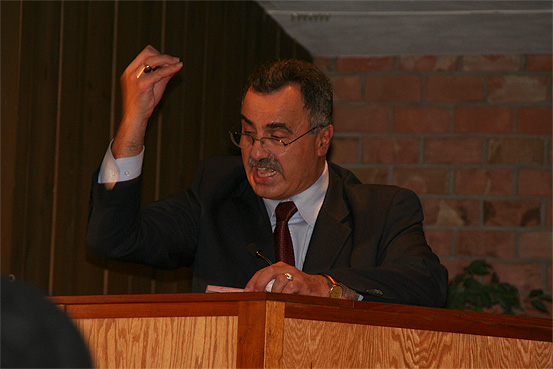
Before becoming a diplomat, Dr. Ajami was a writer and poet...and it showed. Every word that came out of his mouth was dipped in the blood of his people. He was informed, articulate, honest and obviously suffering. And he answered every question--there were dozens--with a directness that is unusual in public figures. He said it like he saw it. And I agreed with almost everything he said. That is until he got into a people's right to fight an occupying army violently. The pacifist in me just can't go there. But except for that, we were on the same page. Actually I was gratified to see that my grasp of the history of the conflict between Lebanon and Israel was pretty accurate.
After the talk I scooted up to Dr. Ajami and his wife to tell them about my friendship with Rabih Haddad and his wife Sulaima Al-Rushaid, both of whom I was sure he'd know. I also told them about my 18-day solitary vigil on Lebanon's behalf in front of the White House. He expressed deep gratitude to me for that. But before we'd said a word, he had surprised me by leaning down to kiss my cheek in greeting. And this from a Muslim man who isn't even supposed to shake hands with a woman who is not his wife. I felt a deep connection between the three of us. His wife was also most gracious. But that's almost to be expected. Graciousness is a national trait of the Lebanese people.
Sunday, August 27, 2006
And now for something completely different...
The following photos were taken by a friend of mine, Ken Rowell. He lives on three acres of land with his wife, children, one horse, eight dogs, one pig, one goat, six cats and assorted other creatures. The first photo is of Wilbur the pig and Kate the border collie. You may recognize Kate as our community park's famous "goose-guard." The kittens in the next photo were so new to the world they had no names as yet. In photo #3 taken a week or so later, two of them are showing off their survival skills.





Saturday, August 26, 2006
Maryann Mahaffey 1925-2006
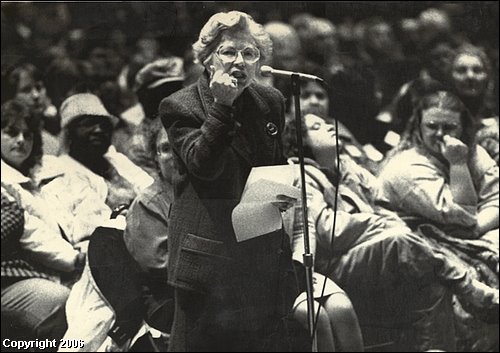
Today Detroit celebrated the life of one of its greatest sheroes: Maryann Mahaffey. Pat Kolon and I were among hundreds who gathered at the Detroit Opera House for three hours to remember Maryann's life of service to the greater good and to personally and communally pledge to carry on her commitment to the poor, women, workers, youth, the gay/lesbian/bisexual/transgender community and all voiceless victims of oppression, economic injustice, institutionalized racism, privatization of services, wars and violence. As her pastor, Ed Rowe, said, if we simply recalled her greatness without commiting ourselves to act in ways that would benefit the community, it would be a mockery of her life and works.
In her own words, Maryann said, "I wonder what it is with me? Then I recognize that I cannot deny my passion. It is true that I feel very firmly about principles. And thus I will carry on."
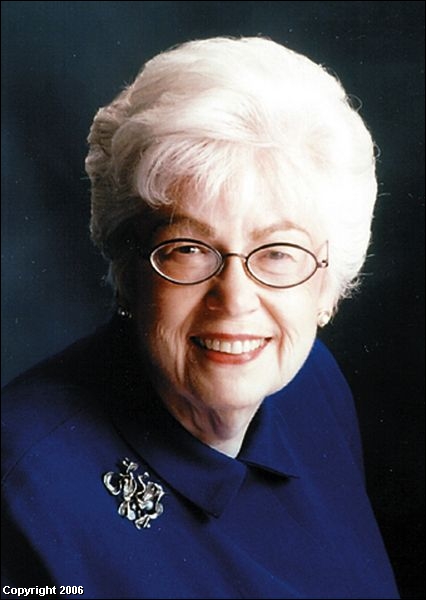 Maryann Mahaffey was elected to the Detroit City Council for eight terms: from 1973 until adult T-cell leukemia forced her to retire in December 2005. For three of those terms she was the Council president by virtue of her having received the most votes. Maryann Mahaffey was the people's politician and everyone knew it. She never forgot those who depended on her as advocate, agitator, organizer, listener, fighter and best friend. For that's how so many saw Maryann Mahaffey.
For me, she was a sister in the peace movement. Always there at rallies and marches, no matter what the weather. Maryann was arrested more than once for causes in which she believed deeply. She just never backed down. Strong, persistent, informed, compassionate, articulate, available and relentless in her fervor, Maryann Mahaffey never used her position for anything but the greater good. A social worker, she used that consciousness to promote social change within the systems of government.
A mentor to more women than I could count--myself among them--Maryann Mahaffey will live on in our works more than in our words.
Here are links to two articles written after her death on Thursday, July 27:
http://www.freep.com/apps/pbcs.dll/article?AID=2006607280372
http://www.detnews.com/apps/pbcs.dll/article?AID=/20060728/OBITUARIES/607280335
Friday, August 25, 2006
healed & happy

After two weeks here with us, I'm pleased to say that our friend Pat is looking like a new person. This was her longest vacation in decades, and Ed and I enjoyed it every bit as much as she. Not only did she feed us well--Pat loves to cook, especially dishes made with vegetables from her garden--but she is such an easy person to have around. We're going to miss her greatly when she returns home to her "other" life tomorrow night. I sure hope she'll come stay with us again soon.
Thursday, August 24, 2006
A woman obsessed
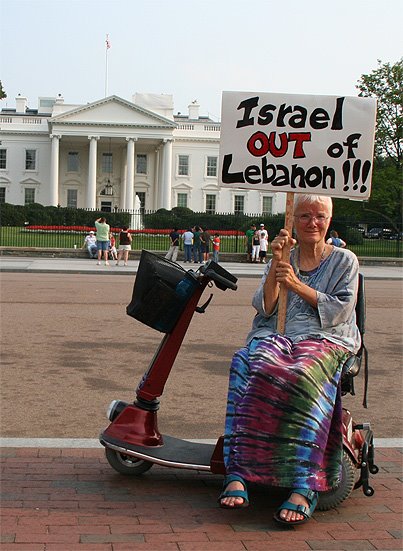
Another of my writing exercises from the retreat:
It wasn't that she had to be seen and heard for herself, although she did have her personal issues with this--remember sister Carolyn's refusing to say "See you in the morning" before going to sleep at night?--it was more that she had to make a difference of some kind, her life had to count for something. What makes me say it was an obsession? Because if she didn't do it she felt she'd die. That might sound strong, but I think it's true.
So on that hot muggy Thursday afternoon in July, after having driven 500 miles by herself, she dropped her suitcase on the bed of her hotel room, got her sign out of the black plastic bag, and set off in her scooter towards the White House, five blocks away.
Could she have imagined that she and her sign would be seen by tens of thousands of persons from around the world over the next 18 days? That some of these persons, including one 9 year-old boy, would scream at her in anger, pain and disgust?
No, she knew none of that, but she did know she could no longer sit at home stewing in her juices, feeling impotent and disempowered over what was happening to the people and land she'd grown to love. She did know she had to be seen and her voice heard--even just the words printed on her sign--by whomever she encountered: tourists, senators, representatives, media, US Park Police, sister and brother activists, visitors to the president, anyone who had eyes to see and language to understand her cry for Israel to get the heck out of Lebanon and leave those suffering people alone.
In her naivete, she believed most readers of her signs would agree with her message. Oh yes, she had a lot to learn.
I say she was obsessed because it didn't matter how tired she was, how hot the day, how mean the people, how alone she felt. For 18 days, day in and day out, she got up from her hotel bed, finished writing and posting her blog account of the day before, took a shower in her wheelchair-accessible bathroom, got dressed, rubbed sunblock on her tattoo, put on her straw hat, picked up her sign and tucked it upside-down between her legs on her scooter, took the freight elevator downstairs, greeted the workers in the hotel restaurant kitchen with an "Hola!", paid $1.50 for an apple or grapefruit or orange juice-to-go at the souvenir shop in the lobby, asked whomever was closest to the front door to please open it, and scooted out onto sidewalks crowded with cell phone-absorbed Washington workers in suits and tourists in t-shirts and shorts with cranky kids in tow.
I say she was obsessed because she kept going back for more. Even after she'd heard hundreds of American voices telling her she should change her sign to say, "Lebanon/terrorists out of Israel." After countless Israeli tourists had come up to her, faces twisted in rage, telling her she didn't know what she was talking about, that she and her sign were hurting their children, that the Israeli people were suffering too and didn't she care about that? Even the boy who yelled at her that she was in a wheelchair because of that sign she carried, a little boy whose mother kept repeating, "Let them die; I want all the Lebanese dead!", whose grandmother stopped to say she'd lost her family in the Holocaust, that she supported everything her country was doing to Lebanon and if I didn't like what my country was doing, I should just get out.
Nothing deterred this woman's obsession with being seen and heard. But it wasn't her face she wanted to bring forth, it was the face of Lebanon, of her family, of the innocents who were suffering in a war not of their choosing.
When people would tell her she should change the wording on her sign she'd say, "Please make your own sign. Come stand here beside me. I welcome your doing that. But I'm here for my family in Lebanon, it's their suffering I must bring forward."
Only on the last hour of the last day did she finally say "Enough already." After being surrounded by eight Israeli men and boys, one of whom showed her the face of pure hatred--the kind of hatred that could and would kill--only after fifteen minutes with his face in hers and his fury poisoning every breath she took, did she call it a day. Even though there was still a white middle-aged American man waiting to bring his complaints to her, she just smiled and said, "I'm sorry, dear, but I'm done for the day" as she scooted off.
This obsession of hers had run its course. She had been seen and heard as best she could. But more importantly, she had seen and heard others. That was the surprise. In the end, that was what made it all worthwhile. That it was she who was changed, not the "other." For in those 18 days she learned something she'd never known before. Oh, she'd thought she knew it, but now she saw that she'd believed it not known it and the difference between "believing" and "knowing" was everything. It was what allowed people like Gandhi and Dr. Martin Luther King, Jr. to meet hatred with love.
And what was that knowing? We all want the same thing. We are made of the same stuff. We want ourselves and our loved ones to be safe. It's that simple.
In every dialogue she had over those long hot days in front of the White House and up on Capitol Hill, whether people agreed or disagreed with her sign--except for the three times when ranting was all they could do--everyone agreed that they wanted their loved ones safe. They also wanted their suffering acknowledged; they wanted to be seen and heard.
How could she argue with that? It was exactly what had sent her onto the streets of Washington, DC with her sign in the first place. What had given her the guts to sit there vulnerable as any one person could be, equally ready to dialogue with the enraged as well as the affirming, willing to ask readers of her blog to donate money to help her pay her $2200 hotel bill, the first time since applying for her grad school scholarship in 1964 that she'd asked anyone for money.
Obsessions are like that. They don't count the cost. They just keep on keepin' on. And so she figures she'll do this for the rest of her life--keep on keepin' on.
This obsession to be seen and heard has been superseded by another, more compelling obsession: the need to do whatever she can to bring peace to our wounded world, to help people recognize their commonalities rather than their differences, to see the faces and hear the voices of those made invisible by wars, oppression and injustice, to become in her very person the change she wants to see in the world, to live life to the full, pushing through every boundary, crossing every border, letting love be her language and truth the scooter on which she rides.
US-Israeli War on Lebanon: Why a Ceasefire Is Not Enough
by Nadine Naber
To be published in upcoming September-October issue of Critical Moment
July 12, 2006
"On day one, they came first to the village of Dweir near Nabatiya in southern Lebanon where an Israeli plane dropped a bomb on the home of a Shia'a Muslim cleric. He was killed. So was his wife. So were eight of his children. One was decapitated. All they could find of a baby was its head and torso which a young villager brandished in fury in front of the cameras. Then the planes visited another home in Dweir and disposed of a family of seven" (The Independent).
August 4, 2006
"30 something workers killed today in Qaa, in the Bekaa, on the border with Homs Syria. They had just finished collecting apples, packing them to be put on board of a truck, and they were having lunch. The Israeli's wasted 2 air strikes on them. The first one hit some of them. The others [who were killed had] gathered to try and help out the wounded and take the dead bodies out." (In this case, almost all the dead were Syrian Kurds) (angryarab.blogspot.com)
Self-Defense or Offensive Destruction?
On July 12th, the Israeli army launched a massive attack on Lebanon. In one month, they have destroyed all of the key bridges and overpasses in the country, all three runways of Beirut's commercial airport, roads, power plants, cell phone towers, and factories. The attack has killed more than 1000 civilians (50% are children), wounded 6,000 and displaced over a million (a quarter of the population). It has destroyed Lebanon's infrastructure, including the destruction of entire villages and neighborhoods. It has created a humanitarian disaster in Lebanon (UN and NGO's are not able to supply people with resources since all of the major roads in the South have been hit). Ambulances cannot operate; food, gas and clean drinking water are running out; hospitals are threatened with running out of fuel.
Throughout its bombing campaign, the Israeli army dropped leaflets through fighter planes on areas of Southern Lebanon warning residents to immediately evacuate before they attack. Official Israeli discourse states that people have been killed because they refused to listen when they were told to leave. Yet Human Rights Watch reports that "many civilians have been unable to flee because they are sick, wounded, do not have the means to leave or are providing essential civil services" and because "the roads are under Israeli attack."
In one of many such cases, when Israeli loudspeakers warned residents to evacuate the village of Marwaheen, families attempted to head for safety and Israeli boats shelled the roads, hitting a pickup but wounding only the women and children in the back. Within minutes, an Israeli helicopter approached, firing a missile that blew the pickup to pieces as the passengers struggled to jump out. Twenty-three members of one family were killed and the only survivor was the brother's four-year-old niece, who suffered severe burns to much of her body. The dead stayed in the sun for hours until people could come and collect them.
At first, U.S. and Israeli leaders justified this war by claiming that two Israeli soldiers have been captured in Lebanon (They have also justified the current invasion of Gaza that killed over 150 Palestinians in Gaza--36 were minors and 20 were women--in July alone on the basis that one Israeli soldier was captured) (see btselem.org). Yet what they failed to report is that over 9,000 Palestinians and an untold number of Lebanese and other Arabs are being held illegally in Israeli prisons and at least 355 are children. Now that it has become ludicrous to justify the destruction of an entire country as a means to free two soldiers, the U.S. and Israel justify this war by claiming they are fighting "Muslim terrorists" who are full of hate and evil and want to destroy Israel.
According to Human Rights Watch, "The Israeli government has blamed Hezbollah for the high civilian casualty toll in Lebanon, insisting that Hezbollah fighters have hidden themselves and their weapons among the civilian population. However, in none of these cases of civilian deaths documented [in the Human Rights Report "Lebanon/Israel"] is there evidence to suggest that Hezbollah was operating in or around during or prior to the attack.
Historical Context
Official U.S. and Israeli discourse on the "terrorists" omits any meaningful discussion on Hizballah, such as who they are, what they represent, and the historical circumstances through which they were created. This is not surprising since "fighting Muslim terrorists" has become a code word for justifying U.S. and Israeli violence against Arab and Muslim civilians and crushing all forms of resistance to U.S.-Israeli policies.
Looking beyond the corporate U.S. media's blackout on the historical circumstances that produced Hizballah, it becomes clear that Israel has been violating Lebanon's sovereignty long before Hizballah existed, long before their capture of two Israeli soldiers--and that Hizballah was born out of resistance to Israel's violations of Lebanon's sovereignty. According to Zeina Zaatari (Voices of the Middle East, August 2),"The Assault started in 1948 with a seizing of 7 villages of south Lebanon alongside the dispossession of Palestinian people. Regular incursions into Lebanon and violations of Lebanon's water, land and air space have been a common practice by the Israeli state for decades. In 1968, Israel bombed the Beirut international airport destroying 13 Middle East airline planes.
Under the guise of expelling the PLO from Lebanon, Israel invaded Lebanon in 1982. Israeli troops attacked West Beirut, killing 20,000 civilians, destroying homes and businesses, and displacing 400,000 people. This is the context out of which Hizballah was created. Following 1982, a number of small groups organized under the banner of Islam dedicated to fighting the Israeli occupation troops and by 1985, officially coalesced into Hizballah. In 1985, Israel withdrew from most of Lebanon, but continued to occupy southern Lebanon (in violation of UN resolutions that affirm that Lebanon is a sovereign country).
Khiam prison was a detention and interrogation camp during the years of the Israeli occupation in Southern Lebanon where thousands of Lebanese were held in Khiam without trial. According to Human Rights Watch in 1999, "Hundreds of Lebanese have been arbitrarily detained in Khiam without charge for indefinite periods of time. Many of the detainees, including women, have been tortured during interrogation and subjected to abysmal conditions of confinement...This prison is operated entirely outside the law...Israel is bound by its obligations under international humanitarian and human rights law to address the violations that continue to occur at Khiam" (October 28, 1999).
During the Israeli occupation of South Lebanon, Hizballah was at the forefront of resistance to Israeli occupation. In 2000, the resistance movement forced Israel to withdraw from Lebanese land although Israel illegally continued to take water from the Litania river and maintain control over Shebaa Farms and Sharhuba Hills. Along with their "withdrawal" from southern Lebanon, Israel left over 300,000 landmines which have, since then, maimed children and killed farmers, fisherman, and shepherds since Israel refused to provide Lebanon with a map of the land mines.
Also since the "withdrawal," Lebanese prisoners, captured 27 years ago remain in Israeli jails. It is in this context that Hizballah captured two Israeli soldiers. According to Lara Deeb (merip.org), "Both sides, on occasion, have broken the 'rules of the game,' though UN observer reports of the numbers of border violations find that Israel has violated the Blue Line between the countries ten times more frequently than Hizballah has."
Beyond its resistance to Israel's occupation, Hizballah represents Lebanon's disenfranchised Shi'ite community (see Deeb, merip.org) and approximately 40% of the Lebanese population, and has profound roots in Lebanese society. According to Deeb, "Hizballah functions as an umbrella organization under which many social welfare institutions are run. Some of these institutions provide monthly support and supplemental nutritional, educational, housing and health assistance for the poor; others focus on supporting orphans; still others are devoted to reconstruction of war-damaged areas. There are also Hizballah-affiliated schools, clinics and low-cost hospitals, including a school for children with Down's syndrome." Destroying Hizballah would thus entail ethnic cleansing.
U.S.-Israeli Objectives
The U.S-Israeli war on Lebanon aimed to destroy popular resistance against Israeli occupation in order to create a proxy state buffered with a "colonized zone" (Israel calls this a "security zone"). Such has been the US-Israeli design for Lebanon for decades. One might ask, if the U.S. and Israel claim they are at war with Hizballah, then why have they completely destroyed Lebanon and bombed Christian neighborhoods where Hizballah is no where to be found? By blaming Hizballah for the destruction, the U.S. and Israel are trying to force the broader Lebanese population into war against Hizballah, thus igniting an internal confessional strife within Lebanon (just as what we have seen in the U.S. plan for Iraq).
The Bush administration is the primary supporter of the Israeli military. It has been sending laser-guided and bunker buster bombs to Israel with full knowledge of the rising death toll and has crushed all proposals for immediate cease-fire in every stage of this war.
As in previous histories of U.S. colonization and expansion, the U.S.'s current plan of "bringing democracy to the Middle East" has meant establishing and supporting puppet governments through military force and destroying those who are freely elected by their people. The majority of people in the Arab region--and throughout the world--fundamentally disagree with U.S. and Israeli policy on the issues of Iraq, Palestine, and Lebanon and disagree with the regimes that the U.S. arms. These policies are based on injustice and inequality. The more injustice the U.S. and Israel bring to the region, the more people will identify with movements that defy U.S. and Israeli plans for the region (see As'ad Abu-Khalil, Voices of the Middle East, August 2nd).
U.S.-led Violence, Racism, and War
Since Israel has extended this war beyond its fight with Hizballah by killing civilians (including those in Christian villages where Hizballah is no where to be found) and destroying Lebanon, one does not need to take a position for or against Hizballah to take a stance for or against this war. One simply needs to consider supporting peace and life or supporting destruction and death. Yet when the leaders of the most powerful nation of the world use race, nation, or religion to grant some bodies more value than others; to grieve the death of some children, but not others; and to grant names and faces to some of the dead and not to others--we might ask whether calling for "life" or "peace"or "cease fire" is even enough.
In 1996, Madeline Albright claimed that the price of killing 5,000 Iraqi children per month was "worth it." In 2006, Condoleeza Rice referred to the destruction, displacement, and killing in Lebanon as the "birth pangs of the new Middle East" and John Bolton, US Ambassador to the UN stated that there is "no moral equivalence" between the deaths of Lebanese and the deaths of Israelis. You may have wondered why an Arab man held up a sign at a recent Ann Arbor protest that read, "Arabs Have Stem Cells Too." Perhaps it is because Bush claims that "every child born and unborn should be protected," yet intentionally supports the killing of Arab children. In Lebanon, Bush's message to the children has been: You are less than human. Your blood has no value. And pro-life doesn't apply to you.
On August 11, the Security Council approved resolution 1701 which calls for an end to the war and a cessation of hostilities. While the resolution calls for Israel to withdraw from Lebanon "in parallel" with the deployment of the Lebanese army and UNIFIL forces in the south, it fails to give an official deadline by which Israel should withdraw. It therefore fails to guarantee Israeli withdrawal. The resolution also gives Israel a green light to enact any military operation as long as it is in "self-defense." Yet since Israel has made no distinction between defensive and offensive wars and has historically defined all of its wars in the region as self-defense, there is no guarantee that this resolution will stop Israeli aggression in Lebanon.
While U.S. liberals celebrate the "cease fire," a number of questions remain unanswered: Why did the Security Council wait an entire month before intervening in the attacks against civilians, and why did the Security Council resolution fail to condemn the systematic killing of civilians? In the beginning of the war, the U.S. blocked the Security Council from calling for a ceasefire on the grounds that, "we must wait for the right conditions for a ceasefire." One month later, now that we are left with the destruction of Lebanon and no guarantee of an end to war, the U.S. accepted a "cease-fire" resolution. For Bush, what then is the difference between the right conditions for a "cease-fire" and the right conditions for bloodshed and war?
One hundred people die in Iraq per day. Over 4,000 Palestinians and over 1000 Israelis killed since 2000 alone. Over 7.2 million Palestinians have become refugees. How many more injustices do we need to hear about before people stop wondering why "they" hate "us?" In a message to the American people on July 31, Mayssoun Sukarieh writes from Lebanon, "We have lost faith in you because your democracy got exported to us with your missiles, and we are consuming them while you are consuming our news."
Nadine Naber is a co-founder and board member of Arab Movement of Women Arising for Justice (AMWAJ). She is an Assistant Professor of Arab American Studies and Gender Studies at the University of Michigan, Ann Arbor.
To be published in upcoming September-October issue of Critical Moment
July 12, 2006
"On day one, they came first to the village of Dweir near Nabatiya in southern Lebanon where an Israeli plane dropped a bomb on the home of a Shia'a Muslim cleric. He was killed. So was his wife. So were eight of his children. One was decapitated. All they could find of a baby was its head and torso which a young villager brandished in fury in front of the cameras. Then the planes visited another home in Dweir and disposed of a family of seven" (The Independent).
August 4, 2006
"30 something workers killed today in Qaa, in the Bekaa, on the border with Homs Syria. They had just finished collecting apples, packing them to be put on board of a truck, and they were having lunch. The Israeli's wasted 2 air strikes on them. The first one hit some of them. The others [who were killed had] gathered to try and help out the wounded and take the dead bodies out." (In this case, almost all the dead were Syrian Kurds) (angryarab.blogspot.com)
Self-Defense or Offensive Destruction?
On July 12th, the Israeli army launched a massive attack on Lebanon. In one month, they have destroyed all of the key bridges and overpasses in the country, all three runways of Beirut's commercial airport, roads, power plants, cell phone towers, and factories. The attack has killed more than 1000 civilians (50% are children), wounded 6,000 and displaced over a million (a quarter of the population). It has destroyed Lebanon's infrastructure, including the destruction of entire villages and neighborhoods. It has created a humanitarian disaster in Lebanon (UN and NGO's are not able to supply people with resources since all of the major roads in the South have been hit). Ambulances cannot operate; food, gas and clean drinking water are running out; hospitals are threatened with running out of fuel.
Throughout its bombing campaign, the Israeli army dropped leaflets through fighter planes on areas of Southern Lebanon warning residents to immediately evacuate before they attack. Official Israeli discourse states that people have been killed because they refused to listen when they were told to leave. Yet Human Rights Watch reports that "many civilians have been unable to flee because they are sick, wounded, do not have the means to leave or are providing essential civil services" and because "the roads are under Israeli attack."
In one of many such cases, when Israeli loudspeakers warned residents to evacuate the village of Marwaheen, families attempted to head for safety and Israeli boats shelled the roads, hitting a pickup but wounding only the women and children in the back. Within minutes, an Israeli helicopter approached, firing a missile that blew the pickup to pieces as the passengers struggled to jump out. Twenty-three members of one family were killed and the only survivor was the brother's four-year-old niece, who suffered severe burns to much of her body. The dead stayed in the sun for hours until people could come and collect them.
At first, U.S. and Israeli leaders justified this war by claiming that two Israeli soldiers have been captured in Lebanon (They have also justified the current invasion of Gaza that killed over 150 Palestinians in Gaza--36 were minors and 20 were women--in July alone on the basis that one Israeli soldier was captured) (see btselem.org). Yet what they failed to report is that over 9,000 Palestinians and an untold number of Lebanese and other Arabs are being held illegally in Israeli prisons and at least 355 are children. Now that it has become ludicrous to justify the destruction of an entire country as a means to free two soldiers, the U.S. and Israel justify this war by claiming they are fighting "Muslim terrorists" who are full of hate and evil and want to destroy Israel.
According to Human Rights Watch, "The Israeli government has blamed Hezbollah for the high civilian casualty toll in Lebanon, insisting that Hezbollah fighters have hidden themselves and their weapons among the civilian population. However, in none of these cases of civilian deaths documented [in the Human Rights Report "Lebanon/Israel"] is there evidence to suggest that Hezbollah was operating in or around during or prior to the attack.
Historical Context
Official U.S. and Israeli discourse on the "terrorists" omits any meaningful discussion on Hizballah, such as who they are, what they represent, and the historical circumstances through which they were created. This is not surprising since "fighting Muslim terrorists" has become a code word for justifying U.S. and Israeli violence against Arab and Muslim civilians and crushing all forms of resistance to U.S.-Israeli policies.
Looking beyond the corporate U.S. media's blackout on the historical circumstances that produced Hizballah, it becomes clear that Israel has been violating Lebanon's sovereignty long before Hizballah existed, long before their capture of two Israeli soldiers--and that Hizballah was born out of resistance to Israel's violations of Lebanon's sovereignty. According to Zeina Zaatari (Voices of the Middle East, August 2),"The Assault started in 1948 with a seizing of 7 villages of south Lebanon alongside the dispossession of Palestinian people. Regular incursions into Lebanon and violations of Lebanon's water, land and air space have been a common practice by the Israeli state for decades. In 1968, Israel bombed the Beirut international airport destroying 13 Middle East airline planes.
Under the guise of expelling the PLO from Lebanon, Israel invaded Lebanon in 1982. Israeli troops attacked West Beirut, killing 20,000 civilians, destroying homes and businesses, and displacing 400,000 people. This is the context out of which Hizballah was created. Following 1982, a number of small groups organized under the banner of Islam dedicated to fighting the Israeli occupation troops and by 1985, officially coalesced into Hizballah. In 1985, Israel withdrew from most of Lebanon, but continued to occupy southern Lebanon (in violation of UN resolutions that affirm that Lebanon is a sovereign country).
Khiam prison was a detention and interrogation camp during the years of the Israeli occupation in Southern Lebanon where thousands of Lebanese were held in Khiam without trial. According to Human Rights Watch in 1999, "Hundreds of Lebanese have been arbitrarily detained in Khiam without charge for indefinite periods of time. Many of the detainees, including women, have been tortured during interrogation and subjected to abysmal conditions of confinement...This prison is operated entirely outside the law...Israel is bound by its obligations under international humanitarian and human rights law to address the violations that continue to occur at Khiam" (October 28, 1999).
During the Israeli occupation of South Lebanon, Hizballah was at the forefront of resistance to Israeli occupation. In 2000, the resistance movement forced Israel to withdraw from Lebanese land although Israel illegally continued to take water from the Litania river and maintain control over Shebaa Farms and Sharhuba Hills. Along with their "withdrawal" from southern Lebanon, Israel left over 300,000 landmines which have, since then, maimed children and killed farmers, fisherman, and shepherds since Israel refused to provide Lebanon with a map of the land mines.
Also since the "withdrawal," Lebanese prisoners, captured 27 years ago remain in Israeli jails. It is in this context that Hizballah captured two Israeli soldiers. According to Lara Deeb (merip.org), "Both sides, on occasion, have broken the 'rules of the game,' though UN observer reports of the numbers of border violations find that Israel has violated the Blue Line between the countries ten times more frequently than Hizballah has."
Beyond its resistance to Israel's occupation, Hizballah represents Lebanon's disenfranchised Shi'ite community (see Deeb, merip.org) and approximately 40% of the Lebanese population, and has profound roots in Lebanese society. According to Deeb, "Hizballah functions as an umbrella organization under which many social welfare institutions are run. Some of these institutions provide monthly support and supplemental nutritional, educational, housing and health assistance for the poor; others focus on supporting orphans; still others are devoted to reconstruction of war-damaged areas. There are also Hizballah-affiliated schools, clinics and low-cost hospitals, including a school for children with Down's syndrome." Destroying Hizballah would thus entail ethnic cleansing.
U.S.-Israeli Objectives
The U.S-Israeli war on Lebanon aimed to destroy popular resistance against Israeli occupation in order to create a proxy state buffered with a "colonized zone" (Israel calls this a "security zone"). Such has been the US-Israeli design for Lebanon for decades. One might ask, if the U.S. and Israel claim they are at war with Hizballah, then why have they completely destroyed Lebanon and bombed Christian neighborhoods where Hizballah is no where to be found? By blaming Hizballah for the destruction, the U.S. and Israel are trying to force the broader Lebanese population into war against Hizballah, thus igniting an internal confessional strife within Lebanon (just as what we have seen in the U.S. plan for Iraq).
The Bush administration is the primary supporter of the Israeli military. It has been sending laser-guided and bunker buster bombs to Israel with full knowledge of the rising death toll and has crushed all proposals for immediate cease-fire in every stage of this war.
As in previous histories of U.S. colonization and expansion, the U.S.'s current plan of "bringing democracy to the Middle East" has meant establishing and supporting puppet governments through military force and destroying those who are freely elected by their people. The majority of people in the Arab region--and throughout the world--fundamentally disagree with U.S. and Israeli policy on the issues of Iraq, Palestine, and Lebanon and disagree with the regimes that the U.S. arms. These policies are based on injustice and inequality. The more injustice the U.S. and Israel bring to the region, the more people will identify with movements that defy U.S. and Israeli plans for the region (see As'ad Abu-Khalil, Voices of the Middle East, August 2nd).
U.S.-led Violence, Racism, and War
Since Israel has extended this war beyond its fight with Hizballah by killing civilians (including those in Christian villages where Hizballah is no where to be found) and destroying Lebanon, one does not need to take a position for or against Hizballah to take a stance for or against this war. One simply needs to consider supporting peace and life or supporting destruction and death. Yet when the leaders of the most powerful nation of the world use race, nation, or religion to grant some bodies more value than others; to grieve the death of some children, but not others; and to grant names and faces to some of the dead and not to others--we might ask whether calling for "life" or "peace"or "cease fire" is even enough.
In 1996, Madeline Albright claimed that the price of killing 5,000 Iraqi children per month was "worth it." In 2006, Condoleeza Rice referred to the destruction, displacement, and killing in Lebanon as the "birth pangs of the new Middle East" and John Bolton, US Ambassador to the UN stated that there is "no moral equivalence" between the deaths of Lebanese and the deaths of Israelis. You may have wondered why an Arab man held up a sign at a recent Ann Arbor protest that read, "Arabs Have Stem Cells Too." Perhaps it is because Bush claims that "every child born and unborn should be protected," yet intentionally supports the killing of Arab children. In Lebanon, Bush's message to the children has been: You are less than human. Your blood has no value. And pro-life doesn't apply to you.
On August 11, the Security Council approved resolution 1701 which calls for an end to the war and a cessation of hostilities. While the resolution calls for Israel to withdraw from Lebanon "in parallel" with the deployment of the Lebanese army and UNIFIL forces in the south, it fails to give an official deadline by which Israel should withdraw. It therefore fails to guarantee Israeli withdrawal. The resolution also gives Israel a green light to enact any military operation as long as it is in "self-defense." Yet since Israel has made no distinction between defensive and offensive wars and has historically defined all of its wars in the region as self-defense, there is no guarantee that this resolution will stop Israeli aggression in Lebanon.
While U.S. liberals celebrate the "cease fire," a number of questions remain unanswered: Why did the Security Council wait an entire month before intervening in the attacks against civilians, and why did the Security Council resolution fail to condemn the systematic killing of civilians? In the beginning of the war, the U.S. blocked the Security Council from calling for a ceasefire on the grounds that, "we must wait for the right conditions for a ceasefire." One month later, now that we are left with the destruction of Lebanon and no guarantee of an end to war, the U.S. accepted a "cease-fire" resolution. For Bush, what then is the difference between the right conditions for a "cease-fire" and the right conditions for bloodshed and war?
One hundred people die in Iraq per day. Over 4,000 Palestinians and over 1000 Israelis killed since 2000 alone. Over 7.2 million Palestinians have become refugees. How many more injustices do we need to hear about before people stop wondering why "they" hate "us?" In a message to the American people on July 31, Mayssoun Sukarieh writes from Lebanon, "We have lost faith in you because your democracy got exported to us with your missiles, and we are consuming them while you are consuming our news."
Nadine Naber is a co-founder and board member of Arab Movement of Women Arising for Justice (AMWAJ). She is an Assistant Professor of Arab American Studies and Gender Studies at the University of Michigan, Ann Arbor.
Wednesday, August 23, 2006
What is lost...
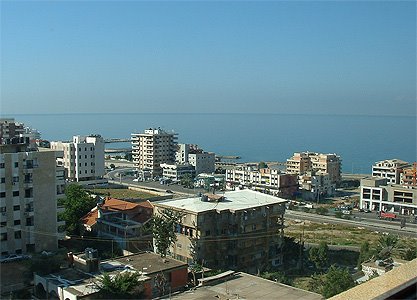
My writing exercises from the retreat, continued:
Ah Lebanon, sparkling land on the shores of the deep blue-green Mediterranean sea. Land of hospitality, beauty, graciousness. Lost in 34 days. Destroyed in the blink of an eye.
The tallest bridge in the Middle East, the one that spanned a mountain pass, gone, rubble, bombed over and over again until it is no more.
The Beirut-Damascus highway from which were views of Lebanon's "breadbasket" cutting through the center of the country from north to south, with the accordion-pleated Syrian mountains hazy in the distance. A highway now closed, craters dotting it surface from Beirut to the Syrian border, craters deep and ugly as a cosmic cesspool.
Neighborhoods in South Beirut that were warrens of life, vehicles everyplace, even parked on sidewalks, people crowded onto streets, walking in the middle of the road with no noticeable concern over the cars, trucks and motorcycles trying to get around them, now mountains of rubble, people's bodies still to be found. Sana's girlfriend's apartment building among them for sure. Is it her body, her mother's body, her father's body, her sisters' and brothers' bodies, her grandmother and grandfather's bodies, her aunts', uncles' and cousins' bodies? Who was saved, who was crushed?
Central Beirut, finally reconstructed after the long civil war, cranes dotting the cosmopolitan skyline, pencil jottings of progress against a scarlet sunset sky, people busy preparing for the next day's Beirut Marathon, sidewalk cafes full of young people chatting as they sip lattes, the haunting sounds of the call to prayer, the mosque where Rabih and Sulaima went inside to pray, the almost-full moon creeping over the balcony's edge of the apartment house to the east of our parked car, everything safe, lovely, exotic and familiar all at the same time.
And now? What would I see today in the center of the city known as the Paris of the Middle East? Did the mosque that had survived since the 12th century survive this time around? I know the old lighthouse at the tip of the peninsula did not. What about the amusement park with its red-lit Ferris wheel? Gone or still there? I know the beautiful white sandy beaches are now black with oil, birds, turtles and fish dead on the shores. Oil out into the sea as far as the eye can see. No longer a lush blue-green, now black and murky with death.
All I can see is how it was, not as it is now, or as it might be tomorrow. I can't even imagine how long it will take for Lebanon to bring itself back to life this time, to restore itself to its former glory. How can these people who have suffered so much turn around and try to rebuild what they have lost? And to what purpose? So Israel can destroy them again and again and again? Israel with the help, support, bombs, money and encouragement of those who sit in positions of power in my own country.
Why bother? But I know they will because that's who they are. An indefatigable people, a people who never give up, who are unbowed by whatever tragedy befalls them. Decade after decade after decade, they pick themselves up and start over again. Rebuilding, re-dreaming, believing. I am the one who cannot imagine restoring what they have lost. But they can. I know they can. It's all they've ever done.
Tuesday, August 22, 2006
Three stories

For the next couple of days I'll be sharing some of what I wrote during the writers' retreat. This first offering includes three exercises that came forward in response to writing prompts given at different times on Friday, our first full day. When it came time to share our writings that night, I put the three together and told them in different voices. As many of you know, I was hoping in my retreat writings to begin to integrate all that I'd experienced during my Lebanon Peace Initiative. This was the start of that process.
Placing myself inside the head and then speaking in the voice of 16 year-old Sana who is now living with her family in Kuwait:
All I want is for the phone to ring and it to be for me. Is that too much to ask? I just want to hear Zeinab's voice on the other end of the line. I want her to ask me if I got question #3 on our history quiz. Or if I'd seen how Batul had played up to Mrs. King-Ahmed when she'd asked if her homework was done yet. Batul NEVER had her homework done on time.
God, but I miss her. And now I don't even know where she is. Or if she's still alive. And now that Mom has a new cell phone number, she couldn't find me even if she tried.
Has it really only been five weeks since our world fell apart? Five weeks since the phone rang and it was for me?
My best friend. The friend I waited for all those years. A friend who understood everything, who knew what I was going to say before I said it, who was like the sister I'd always wanted, like Lailah in Ann Arbor. Another best friend I lost.
I know Mom and Dad say I'll make another friend, but how long will it take this time? Patricia says she's going to work her "magic" to get me a friend really soon. She knew exactly how I felt. How did she know? I didn't say anything, but she knew.
Is it too much to ask for this? Should I be praying for my Mom, that she be given what she needs to make this new life in yet another country? Is it selfish for me to bother God with little things like a friend?
I mean we're lucky to be alive. We could have been killed. That road we were on getting out of Lebanon was bombed the next morning. We could have been on it when it was bombed. And what about our expired passports? Sami, Oussama and I could have been turned back at the Syrian border. What would Mom have done then? Would the bus have taken us back to Hammana?
So just wanting the phone to ring and having my friend's voice at the other end is incredibly self-centered. Like I ought to be thanking God, not asking him for more. We're so much luckier than so many people. Gosh, I don't even know about all the kids at school. Or the teachers. Or the doorman at the apartment. Or Fatima who cooked for us. Or our doctor. Or the grocer. Or anybody.
Why don't I think about them? Instead all I think about is myself.
Will I ever have a best friend again? Patricia thinks so. I hope she's right. Oh, how I hope she's right.
There's Mom's phone ringing again. Let it be for me. Please God, please. Let it be for me.
******************************
Placing myself inside the head and then speaking in the voice of the former Israeli settler I encountered on the last hour of the last day of my 18-day vigil in front of the White House:
What in the hell does she mean, "Israel out of Lebanon"? We belong there. Those people are all terrorists and they want us dead...they want me dead. They took my home away from me. All those Arabs are alike. They just want us dead and gone. Where does she come off telling me we should get out of Lebanon? Hell, they made me leave my home. They pulled me away kicking and screaming. I have no home. I have no home so why should they? Why the hell should they.
Get out of here with that sign, you fool! You don't know what you're talking about. You with your Christian-white hair and pale skin. You've got a home, why can't I? Why should we sit back and let those Arab terrorists bomb our people, make them run from their homes, make them live in shelters? We need to kill them all. They aren't human. They're subhuman. Take them out. Do whatever it takes to get them off our land. Lebanon, Palestine. It's all the same. They just want me dead and gone. And here's this goddamn woman telling me that Israel should get out of Lebanon!
Let her live there. Let her live in a country where all her neighbors want her dead. We have to defend ourselves. We Jews have always had to defend ourselves. Look at Hitler. Look at the Holocaust. Look at the Pogroms back in Russia. Look at the anti-Semitism here in the US. That's what she is--she's just a damn anti-Semite. She hates us Jews as much as her so-called "family" in Lebanon does. Family, hell. They're all terrorists. They want me dead. Even those kids. They're being raised to hate me. Hell, the maps in their schools don't even have Israel on them. That's what they want. They want our homeland to go back to those Arabs, those people who didn't do a thing to make it a good land before we got there. Hell, back then it was wasteland. And now? We Jews have made it the Promised Land...our land. That's what Yahweh intended. This is OUR land, not theirs.
Get Israel out of Lebanon? Hell, get those Arab terrorists out of our homeland. That's what has to happen!
***********************************
Telling Joey's story--the Iraq War veteran I met at the ice cream parlor one night--with a more hopeful ending than what really happened:
His first question was, "What does your sign say?" An hour later, he asked, "Do you think the President would sit down and talk to me? A man who fought in his war?" And finally, "Will I ever get over being crazy?"
Joey is 21 years old, blond hair cut short in the military-style. He has deep lines on his forehead that crease when he lifts his eyebrows. He loves chocolate ice cream, his blue-patterned Italian shirt that the army gave him when they released him this afternoon from the psych unit at Walter Reed Army Hospital. He hurried up as we walked down Pennsylvania Avenue late tonight. "You wouldn't walk down a street like this in Baghdad," he said, shaking his head and looking around him.
He feels safe at the Gifford's Ice Cream parlor where we met. "Let's go back there," he said after I'd shown him the White House.
When he'd asked the guard at the West Gate if he could see the president, what if instead of putting him off, he'd said, "Sure, son, come on in. I know Mr. Bush would want to thank you personally for fighting in his war."
Joey would have straightened his shoulders, held his head up high, puffed out his chest and smiled. The lines would have disappeared on his forehead. I would have waited for as long as it took for him to come back. Twenty minutes? Thirty? He wasn't asking for much, just a brief thank you from the man who he said had started the war that made him crazy.
I don't think I would have recognized him after those few minutes. He would have looked 21 not 51, happy not anxious. He would have been all there not riding on six instead of twelve cylinders. He would have almost skipped instead of skulked. He would have looked at me as he told me all about it, instead of scouring the street for snipers. His voice would have sounded confident instead of cowering in his closed-up throat.
Joey, whole, young, happy, optimistic, glad to be alive, looking forward to what came next. Joey as a young man just starting out in life. A young man with a wife who loved him and was waiting for him back home in Kentucky. Joey as he was before he went to fight in Mr. Bush's war.
Monday, August 21, 2006
Perfection!

Anya Achtenberg and Demetria Martinez's writers' retreat--"Yearning and Justice: Writing the Unlived Life"--at Leaven Center was exactly what I needed! And being in such a loving, talented, truth-filled circle of women only added to its perfection. Ten of the fourteen participants were returnees from last summer's retreat with Anya and Demetria, so we already knew and trusted one another. We were graced by the presence of four new women whose unique voices and gifts made our circle complete. Add to that the joy of being in a cedar-built lodge beside a river so grand that is its name, surrounded by 40 acres of meadows and forests with a gurgling creek and cattail-dotted pond, and you can see why I call it perfection. What follows is an exercise I wrote today, the last day of our retreat:
It wasn't the flat plate of white star-shaped blossoms that caught my eye that first morning, but the cupped hand of possibilities, the furry-green sphere dotted with black seeds, each awaiting its moment to shine. It was the safety with which they were being held, protected from any threats to their existence, that appealed to me, their being given the opportunity to screw up their courage before daring to emerge into fullness.
Nothing is more vulnerable than Queen Anne's Lace in full bloom on a meadow in August. It is a hand that says, "Here I am, world! Open to whatever comes."
After having been that open hand myself for eighteen days on the crowded sidewalks in front of the White House, I know how it feels. My sign was the flat plate of blossoms I offered the world. My body was the unprotected stalk on which it swayed. Once I took my sign and held it aloft, I was fair game. "Here I am, folks, come and get me." And they did, wondrously, challengingly, lovingly, terrifyingly.
So here I came four days ago, tired of being open and vulnerable. I wanted to be held protected and safe within the cupped hand of this land I know I can trust. Here I am safe. Here I can let down my guard. Here I can say what I think, not what I hope will allow for nonviolent dialogue.
Such dialogue is fine and good and necessary, but there comes the time when even the peacemaker must rest. When she who puts herself in the place of global connectedness can lay back and simply BE. Be held in the hand of a circle of women who see, hear, value and understand her in ways that will allow her all the time it takes to unfold into the mystery of her next blooming, time to form new seeds of hope, a more inclusive plate of blossoms, a stronger stalk on which to sway.
Held this way I can imagine the peace for which I yearn, a world where each person can bloom into their fullness knowing they will be accepted for who they are. A place were the words "Peace is possible" no longer make people shake their heads and sigh. A world where the unlived life can live.
Wednesday, August 16, 2006
writers retreat
I'm off tomorrow (Thursday) for a four-day writers retreat at Leaven Center. It is being facilitated by Anya Achtenberg and Demetria Martinez, the writers with whom I took a similar workshop last summer. My hope/intention is to use their writing prompts to begin to express and integrate the powerful experiences of my 18-day Lebanon Peace Initiative.
This is how the retreat is described in the Leaven brochure:
August 17 - 21, 2006
Yearning and Justice: Writing the Unlived Life
Within each of us resides an unlived life hidden within the life we live in order to survive. This land of yearning is bordered by frustration, overwork, distraction, or violence ~ large and small. Nevertheless, a deep desire persists: to create and to fulfill all that we have not done or said, have not lived or been able to express.
Exploring our conscious and unconscious yearnings opens us to a rich source of creativity as we uncover the core of what we strain for as we write ~ to express the inexpressible. Writing the unlived life enables us to give expression to our longings for a world transformed where peace, justice, and community flourish, where there is safety and an end to unnecessary suffering, where each person's full potential is realized.
As storytellers and poets of this unlived life, we will work together to create the stories and poems, essays and articles, that convey aspects of our lives previously silenced or hidden. This workshop offers ideas for, and practice in, ways of accessing the unlived life so that we give birth to powerful images, complex characters, and a deepened analysis of the world around and within us. There will be room for many kinds of writing and many kinds of writers. We will read, write, and share our writing with one another (by choice, never by obligation).
Event is gender inclusive
Leaders: Demetria Martinez and Anya Achtenberg
Time: Thursday, 7 pm - Monday, 1 pm
Cost: $300 ($100 deposit and $200 balance due)
Demetria Martinez of Albuquerque, New Mexico, is the author of a novel, Mother Tongue, winner of a Western States Book Award for fiction; and three collections of poetry, including Breathing Between the Lines. Mother Tongue is based in part upon her 1987 indictment in connection with the Sanctuary Movement. She is summer writing faculty at the William Joiner Center for the Study of War and Social Consequences at UMass Boston. She lectures widely and writes a column about social justice issues for the National Catholic Reporter.
Anya Achtenberg lives in Albuquerque, New Mexico and has taught creative writing in many places, including New York, Boston, St. Paul, and Albuquerque. She is the recipient of numerous literary prizes. Her novella, The Stories of Devil-girl, was released on CD in 2003, and her second book of poetry, The Stone of Language, published by West End Press in 2004, includes poems awarded first prizes from Southern Poetry Review and Another Chicago Magazine. Her novel-in-progress, More Than The Wind, has been excerpted in Harvard Review.
See you next Monday evening...
This is how the retreat is described in the Leaven brochure:
August 17 - 21, 2006
Yearning and Justice: Writing the Unlived Life
Within each of us resides an unlived life hidden within the life we live in order to survive. This land of yearning is bordered by frustration, overwork, distraction, or violence ~ large and small. Nevertheless, a deep desire persists: to create and to fulfill all that we have not done or said, have not lived or been able to express.
Exploring our conscious and unconscious yearnings opens us to a rich source of creativity as we uncover the core of what we strain for as we write ~ to express the inexpressible. Writing the unlived life enables us to give expression to our longings for a world transformed where peace, justice, and community flourish, where there is safety and an end to unnecessary suffering, where each person's full potential is realized.
As storytellers and poets of this unlived life, we will work together to create the stories and poems, essays and articles, that convey aspects of our lives previously silenced or hidden. This workshop offers ideas for, and practice in, ways of accessing the unlived life so that we give birth to powerful images, complex characters, and a deepened analysis of the world around and within us. There will be room for many kinds of writing and many kinds of writers. We will read, write, and share our writing with one another (by choice, never by obligation).
Event is gender inclusive
Leaders: Demetria Martinez and Anya Achtenberg
Time: Thursday, 7 pm - Monday, 1 pm
Cost: $300 ($100 deposit and $200 balance due)
Demetria Martinez of Albuquerque, New Mexico, is the author of a novel, Mother Tongue, winner of a Western States Book Award for fiction; and three collections of poetry, including Breathing Between the Lines. Mother Tongue is based in part upon her 1987 indictment in connection with the Sanctuary Movement. She is summer writing faculty at the William Joiner Center for the Study of War and Social Consequences at UMass Boston. She lectures widely and writes a column about social justice issues for the National Catholic Reporter.
Anya Achtenberg lives in Albuquerque, New Mexico and has taught creative writing in many places, including New York, Boston, St. Paul, and Albuquerque. She is the recipient of numerous literary prizes. Her novella, The Stories of Devil-girl, was released on CD in 2003, and her second book of poetry, The Stone of Language, published by West End Press in 2004, includes poems awarded first prizes from Southern Poetry Review and Another Chicago Magazine. Her novel-in-progress, More Than The Wind, has been excerpted in Harvard Review.
See you next Monday evening...
Tuesday, August 15, 2006
Israeli Leaders Fault Bush on War
By Robert Parry
August 13, 2006
http://www.consortiumnews.com/2006/081206.html
Amid the political and diplomatic fallout from Israel's faltering invasion of Lebanon, some Israeli officials are privately blaming President George W. Bush for egging Prime Minister Ehud Olmert into the ill-conceived military adventure against the Hezbollah militia in south Lebanon.
Bush conveyed his strong personal support for the military offensive during a White House meeting with Olmert on May 23, according to sources familiar with the thinking of senior Israeli leaders.
Olmert, who like Bush lacks direct wartime experience, agreed that a dose of military force against Hezbollah might damage the guerrilla group's influence in Lebanon and intimidate its allies, Iran and Syria, countries that Bush has identified as the chief obstacles to U.S. interests in the Middle East.
As part of Bush's determination to create a "new Middle East" - one that is more amenable to U.S. policies and desires - Bush even urged Israel to attack Syria, but the Olmert government refused to go that far, according to Israeli sources.
One source said some Israeli officials thought Bush's attack-Syria idea was "nuts" since much of the world would have seen the bombing campaign as overt aggression.
In an article on July 30, the Jerusalem Post referred to Bush's interest in a wider war involving Syria. Israeli "defense officials told the Post last week that they were receiving indications from the US that America would be interested in seeing Israel attack Syria," the newspaper reported.
While balking at an expanded war into Syria, Olmert did agree on the need to show military muscle in Lebanon as a prelude to facing down Iran over its nuclear program, which Olmert has called an "existential" threat to Israel.
With U.S. forces bogged down in Iraq, Bush and his neoconservative advisers saw the inclusion of Israeli forces as crucial for advancing a strategy that would punish Syria for supporting Iraqi insurgents, advance the confrontation with Iran and isolate Hezbollah in Lebanon and Hamas in Gaza.
But the month-long war has failed to achieve its goals of destroying Hezbollah forces in south Lebanon or intimidating Iran and Syria.
Instead, Hezbollah guerrillas fought Israeli troops to a virtual standstill in villages near the border and much of the world saw Israel's bombing raids across Lebanon - which killed hundreds of civilians - as "disproportionate."
Now, as the conflict winds down, some Israeli officials are ruing the Olmert-Bush pact on May 23 and fault Bush for pushing Olmert into the conflict.
Building Pressure
Soon after the May 23 meeting in Washington, Israel began to ratchet up pressure on the Hamas-led government in the Palestinian territories and on Hezbollah and other Islamic militants in Lebanon. As part of this process, Israel staged low-key attacks in both Lebanon and Gaza. [For details, see Consortiumnews.com "A 'Pretext' War in Lebanon."]
The tit-for-tat violence led to the Hamas seizure of an Israeli soldier on June 24 and then to Israeli retaliatory strikes in Gaza. That, in turn, set the stage for Hezbollah's attack on an Israeli outpost and the capture of two more Israeli soldiers on July 12.
Hezbollah's July 12 raid became the trigger that Bush and Olmert had been waiting for. With the earlier attacks unknown or forgotten, Israel and the U.S. skillfully rallied international condemnation of Hezbollah for what was called an unprovoked attack and a "kidnapping" of Israeli soldiers.
Behind the international criticism of Hezbollah, Bush and Olmert justified an intense air campaign against Lebanese targets, killing civilians and destroying much of Lebanon's commercial infrastructure. Israeli troops also crossed into southern Lebanon with the intent of delivering a devastating military blow against Hezbollah, which retaliated by firing Katyusha rockets into Israel.
However, the Israeli operation was eerily reminiscent of the disastrous U.S. invasion and occupation of Iraq. Like the U.S. assault, Israel relied heavily on "shock and awe" air power and committed an inadequate number of soldiers to the battle.
Israeli newspapers have been filled with complaints from soldiers who say some reservists weren't issued body armor while other soldiers found their equipment either inferior or inappropriate to the battlefield conditions.
Israeli troops also encountered fierce resistance from Hezbollah guerrillas, who took a page from the Iraqi insurgents by using explosive booby traps and ambushes to inflict heavier than expected casualties on the Israelis.
Channel 2 in Israel disclosed that several top military commanders wrote a letter to Lt. Gen. Dan Halutz, the chief of staff, criticizing the war planning as chaotic and out of line with the combat training of the soldiers and officers. [Washington Post, Aug. 12, 2006]
One Israeli plan to use llamas to deliver supplies in the rugged terrain of south Lebanon turned into an embarrassment when the animals simply sat down.
Reporter Nahum Barnea, who traveled with an Israeli unit in south Lebanon, compared the battle to "the famous Tom and Jerry cartoons" with the powerful Israeli military playing the role of the cat Tom and the resourceful Hezbollah guerrillas playing the mouse Jerry. "In every conflict between them, Jerry wins," Barnea wrote.
Olmert Criticized
Back in Israel, some leading newspapers have begun calling for Olmert's resignation.
"If Olmert runs away now from the war he initiated, he will not be able to remain prime minister for even one more day," the newspaper Haaretz wrote in a front-page analysis. "You cannot lead an entire nation to war promising victory, produce humiliating defeat and remain in power.
"You cannot bury 120 Israelis in cemeteries, keep a million Israelis in shelters for a month and then say, 'Oops, I made a mistake.'" [See Washington Post, Aug. 12, 2006]
For his part, Bush spent July and early August fending off international demands for an immediate cease-fire. Bush wanted to give Olmert as much time as possible to bomb targets across Lebanon and dislodge Hezbollah forces in the south.
But instead of turning the Lebanese population against Hezbollah - as Washington and Tel Aviv had hoped - the devastation rallied public support behind Hezbollah.
As the month-long conflict took on the look of a public-relations disaster for Israel, the Bush administration dropped its resistance to international cease-fire demands and joined with France in crafting a United Nations plan for stopping the fighting.
Quoting "a senior administration official" with Bush at his ranch in Crawford, Texas, the New York Times reported that "it increasingly seemed that Israel would not be able to achieve a military victory, a reality that led the Americans to get behind a cease-fire." [NYT, Aug. 12, 2006]
But the repercussions from Israel's failed Lebanon offensive are likely to continue. Olmert must now confront the political damage at home and the chief U.S. adversaries in the Middle East may be emboldened by the outcome, more than chastened.
As in the Iraq War, Bush has revealed again how reliance on tough talk and military might can sometimes undercut - not build up - U.S. influence in the strategically important Middle East.
Robert Parry broke many of the Iran-Contra stories in the 1980s for the Associated Press and Newsweek. His latest book, Secrecy &Privilege: Rise of the Bush Dynasty from Watergate to Iraq, can be ordered at secrecyandprivilege.com. It's also available at Amazon.com, as is his 1999 book, Lost History: Contras, Cocaine, the Press & 'Project Truth.'
August 13, 2006
http://www.consortiumnews.com/2006/081206.html
Amid the political and diplomatic fallout from Israel's faltering invasion of Lebanon, some Israeli officials are privately blaming President George W. Bush for egging Prime Minister Ehud Olmert into the ill-conceived military adventure against the Hezbollah militia in south Lebanon.
Bush conveyed his strong personal support for the military offensive during a White House meeting with Olmert on May 23, according to sources familiar with the thinking of senior Israeli leaders.
Olmert, who like Bush lacks direct wartime experience, agreed that a dose of military force against Hezbollah might damage the guerrilla group's influence in Lebanon and intimidate its allies, Iran and Syria, countries that Bush has identified as the chief obstacles to U.S. interests in the Middle East.
As part of Bush's determination to create a "new Middle East" - one that is more amenable to U.S. policies and desires - Bush even urged Israel to attack Syria, but the Olmert government refused to go that far, according to Israeli sources.
One source said some Israeli officials thought Bush's attack-Syria idea was "nuts" since much of the world would have seen the bombing campaign as overt aggression.
In an article on July 30, the Jerusalem Post referred to Bush's interest in a wider war involving Syria. Israeli "defense officials told the Post last week that they were receiving indications from the US that America would be interested in seeing Israel attack Syria," the newspaper reported.
While balking at an expanded war into Syria, Olmert did agree on the need to show military muscle in Lebanon as a prelude to facing down Iran over its nuclear program, which Olmert has called an "existential" threat to Israel.
With U.S. forces bogged down in Iraq, Bush and his neoconservative advisers saw the inclusion of Israeli forces as crucial for advancing a strategy that would punish Syria for supporting Iraqi insurgents, advance the confrontation with Iran and isolate Hezbollah in Lebanon and Hamas in Gaza.
But the month-long war has failed to achieve its goals of destroying Hezbollah forces in south Lebanon or intimidating Iran and Syria.
Instead, Hezbollah guerrillas fought Israeli troops to a virtual standstill in villages near the border and much of the world saw Israel's bombing raids across Lebanon - which killed hundreds of civilians - as "disproportionate."
Now, as the conflict winds down, some Israeli officials are ruing the Olmert-Bush pact on May 23 and fault Bush for pushing Olmert into the conflict.
Building Pressure
Soon after the May 23 meeting in Washington, Israel began to ratchet up pressure on the Hamas-led government in the Palestinian territories and on Hezbollah and other Islamic militants in Lebanon. As part of this process, Israel staged low-key attacks in both Lebanon and Gaza. [For details, see Consortiumnews.com "A 'Pretext' War in Lebanon."]
The tit-for-tat violence led to the Hamas seizure of an Israeli soldier on June 24 and then to Israeli retaliatory strikes in Gaza. That, in turn, set the stage for Hezbollah's attack on an Israeli outpost and the capture of two more Israeli soldiers on July 12.
Hezbollah's July 12 raid became the trigger that Bush and Olmert had been waiting for. With the earlier attacks unknown or forgotten, Israel and the U.S. skillfully rallied international condemnation of Hezbollah for what was called an unprovoked attack and a "kidnapping" of Israeli soldiers.
Behind the international criticism of Hezbollah, Bush and Olmert justified an intense air campaign against Lebanese targets, killing civilians and destroying much of Lebanon's commercial infrastructure. Israeli troops also crossed into southern Lebanon with the intent of delivering a devastating military blow against Hezbollah, which retaliated by firing Katyusha rockets into Israel.
However, the Israeli operation was eerily reminiscent of the disastrous U.S. invasion and occupation of Iraq. Like the U.S. assault, Israel relied heavily on "shock and awe" air power and committed an inadequate number of soldiers to the battle.
Israeli newspapers have been filled with complaints from soldiers who say some reservists weren't issued body armor while other soldiers found their equipment either inferior or inappropriate to the battlefield conditions.
Israeli troops also encountered fierce resistance from Hezbollah guerrillas, who took a page from the Iraqi insurgents by using explosive booby traps and ambushes to inflict heavier than expected casualties on the Israelis.
Channel 2 in Israel disclosed that several top military commanders wrote a letter to Lt. Gen. Dan Halutz, the chief of staff, criticizing the war planning as chaotic and out of line with the combat training of the soldiers and officers. [Washington Post, Aug. 12, 2006]
One Israeli plan to use llamas to deliver supplies in the rugged terrain of south Lebanon turned into an embarrassment when the animals simply sat down.
Reporter Nahum Barnea, who traveled with an Israeli unit in south Lebanon, compared the battle to "the famous Tom and Jerry cartoons" with the powerful Israeli military playing the role of the cat Tom and the resourceful Hezbollah guerrillas playing the mouse Jerry. "In every conflict between them, Jerry wins," Barnea wrote.
Olmert Criticized
Back in Israel, some leading newspapers have begun calling for Olmert's resignation.
"If Olmert runs away now from the war he initiated, he will not be able to remain prime minister for even one more day," the newspaper Haaretz wrote in a front-page analysis. "You cannot lead an entire nation to war promising victory, produce humiliating defeat and remain in power.
"You cannot bury 120 Israelis in cemeteries, keep a million Israelis in shelters for a month and then say, 'Oops, I made a mistake.'" [See Washington Post, Aug. 12, 2006]
For his part, Bush spent July and early August fending off international demands for an immediate cease-fire. Bush wanted to give Olmert as much time as possible to bomb targets across Lebanon and dislodge Hezbollah forces in the south.
But instead of turning the Lebanese population against Hezbollah - as Washington and Tel Aviv had hoped - the devastation rallied public support behind Hezbollah.
As the month-long conflict took on the look of a public-relations disaster for Israel, the Bush administration dropped its resistance to international cease-fire demands and joined with France in crafting a United Nations plan for stopping the fighting.
Quoting "a senior administration official" with Bush at his ranch in Crawford, Texas, the New York Times reported that "it increasingly seemed that Israel would not be able to achieve a military victory, a reality that led the Americans to get behind a cease-fire." [NYT, Aug. 12, 2006]
But the repercussions from Israel's failed Lebanon offensive are likely to continue. Olmert must now confront the political damage at home and the chief U.S. adversaries in the Middle East may be emboldened by the outcome, more than chastened.
As in the Iraq War, Bush has revealed again how reliance on tough talk and military might can sometimes undercut - not build up - U.S. influence in the strategically important Middle East.
Robert Parry broke many of the Iran-Contra stories in the 1980s for the Associated Press and Newsweek. His latest book, Secrecy &Privilege: Rise of the Bush Dynasty from Watergate to Iraq, can be ordered at secrecyandprivilege.com. It's also available at Amazon.com, as is his 1999 book, Lost History: Contras, Cocaine, the Press & 'Project Truth.'
Monday, August 14, 2006
Thank god they're safe
This is the first time I've cried since it all began. And they're tears of relief, not sadness.
I just got off the phone after talking with every single member of my family in Kuwait except Rabih who had to go to Qatar three days ago for a conference. Sami (14) whose voice had changed. Sulaima who told me only part of the story of their escape...the part up until they made it into Syria. Sana (16) who I've been most worried about and with good reason. Her heart is broken at losing her new best frind. After having lost her best friend in Ann Arbor, Michigan when she and her family were deported in July 2003, it had taken her until six months ago to find another girlfriend of her heart. And now? She has to start all over again. I promised her I'm going to work my very best magic and find her a best friend in Kuwait QUICKLY. Rami (12) who is a writer and whom I encouraged to write down all of his thoughts and feelings about what has happened. He said that sounded great, "Then I could get it out." Oussama (8) who said, "Don't worry about us, Patricia. We're OK now." He also said, "I miss you SO much, Patricia!" Little Braheem whose voice filled the phone with the babble of a two year-old. Braheem who apparently won't let his mother out of his sight, who screams if she puts on her scarf even just to pray or go outside to hang clothes.
Sulaima says she now stutters. Sana said she wakes up every hour throughout the night, and jumps even when she hears the sound of her alam clock ticking. Braheem who won't let his mother out of his sight.
The traumas of war.
After the International Airport five minutes from their apartment in a southern suburb of Beirut was bombed twice--the second, hitting the fuel tanks--Sulaima found a kindly old taxicab driver to take them the (normally) hour's drive up to the family home in Hammana on Mount Lebanon. They left the cat with their cook who lived nearby. But fifteen minutes after they arrived in Hammana, the Israelis started bombing that area. "Right next to our house," as they described it. TV towers, transformers, bridges, roads...all bombed. 20-25 bombs a day. In the middle of all this, Sulaima talked the elderly taxicab driver into driving her back down to Beirut so she could get the cat and gather up necessary papers and things.
I'd been worrying about the cat and how leaving him behind must be upsetting Sulaima and the kids. They'd gotten that little kitty while I was there last November and loved him dearly.
I told Sulaima I sure am glad I didn't know she was going back to Beirut after she'd gotten them up to Hammana or I would have freaked!
Anyway, she managed to connect with the Kuwaiti embassy and get them on a bus that was evacuating Kuwaiti citizens--Sulaima is Kuwaiti--after having lived through the bombardment of Hammana for three days. She paid the taxicab driver more money to drive the kitty cat back down to Beirut to their apartment. Apparently a family who had had to leave their home in the south of Lebanon is temporarily staying there, so they could take care of the cat. Sana said she's told her Dad that as soon as he can get to their old apartment, she wants him to get the cat and bring him to Kuwait. As she said, "He doesn't do well with strangers. Besides, he's a very emotional cat. He must be very depressed."
The worries of war.
If you remember, Rabih had been caught in Istanbul during all of this and couldn't find any way to get back home. So there was Sulaima, responsible for getting all five children safely out of Lebanon. The Kuwaiti bus was picking up passengers at the next village over from Hammana, so that worked out well. The bus took the only road that was still open into Syria, a road that was bombed and then closed the next morning. They waited six hours at the border and had to deal wth the fact that three of the kids' passports had expired. "It was crazy," Sulaima said, "people everyplace, crowds and crowds of people." But the border guards happily weren't sticking too closely to the rules and let the kids' expired passports go through.
Oh yes, I almost forgot. When the bus made a brief stop, one of the boys had to go to the bathroom, so he and Sulaima got off the bus and ran as quickly as they could to try to find a toilet. As she described it, "We finally found a small dirty room in a nearby building that had two tiny toilet stalls. I could hear a woman with an American accent saying to her son exactly what I was saying to mine--'Stand at the toilet, don't you dare sit down, and do your business!" She said, "We both laughed when we heard each other saying the same thing." But then they had to run to try to catch the bus--it was already moving away by the time they got there! But, thank god, it stopped and let them on.
That was as far as Sulaima had the time and energy to take me during this, our first long phone visit since their world came apart on July 12th. She said we'll pick up from here when we talk again. Which, by the way, can be on a regular basis. I recently bought a phone card online that lets me call Kuwait for 14 cents a minute! We talked for 50 minutes today for only $7. Amazing!
When I asked Sana if she'd been able to bring any of her precious things along on the journey, she said, "Yes, a few books and the journal a dear friend from Michigan gave me." That was the journal I'd given her when I'd visited last November.
Today was the first time I'd been able to talk with any of the kids since July 12th. Boy, did I need to hear their voices, to be able to tell them I loved them and hear the same back from them.
I've never before considered the possibility of visiting Kuwait, but now? The kids said it's been REALLY hot since they got there a couple of weeks ago, but I bet spring is lovely in Kuwait. Who knows where I might end up come April or May. Life has a way of surprising you if you let it.
Thank god they're safe.
I just got off the phone after talking with every single member of my family in Kuwait except Rabih who had to go to Qatar three days ago for a conference. Sami (14) whose voice had changed. Sulaima who told me only part of the story of their escape...the part up until they made it into Syria. Sana (16) who I've been most worried about and with good reason. Her heart is broken at losing her new best frind. After having lost her best friend in Ann Arbor, Michigan when she and her family were deported in July 2003, it had taken her until six months ago to find another girlfriend of her heart. And now? She has to start all over again. I promised her I'm going to work my very best magic and find her a best friend in Kuwait QUICKLY. Rami (12) who is a writer and whom I encouraged to write down all of his thoughts and feelings about what has happened. He said that sounded great, "Then I could get it out." Oussama (8) who said, "Don't worry about us, Patricia. We're OK now." He also said, "I miss you SO much, Patricia!" Little Braheem whose voice filled the phone with the babble of a two year-old. Braheem who apparently won't let his mother out of his sight, who screams if she puts on her scarf even just to pray or go outside to hang clothes.
Sulaima says she now stutters. Sana said she wakes up every hour throughout the night, and jumps even when she hears the sound of her alam clock ticking. Braheem who won't let his mother out of his sight.
The traumas of war.
After the International Airport five minutes from their apartment in a southern suburb of Beirut was bombed twice--the second, hitting the fuel tanks--Sulaima found a kindly old taxicab driver to take them the (normally) hour's drive up to the family home in Hammana on Mount Lebanon. They left the cat with their cook who lived nearby. But fifteen minutes after they arrived in Hammana, the Israelis started bombing that area. "Right next to our house," as they described it. TV towers, transformers, bridges, roads...all bombed. 20-25 bombs a day. In the middle of all this, Sulaima talked the elderly taxicab driver into driving her back down to Beirut so she could get the cat and gather up necessary papers and things.
I'd been worrying about the cat and how leaving him behind must be upsetting Sulaima and the kids. They'd gotten that little kitty while I was there last November and loved him dearly.
I told Sulaima I sure am glad I didn't know she was going back to Beirut after she'd gotten them up to Hammana or I would have freaked!
Anyway, she managed to connect with the Kuwaiti embassy and get them on a bus that was evacuating Kuwaiti citizens--Sulaima is Kuwaiti--after having lived through the bombardment of Hammana for three days. She paid the taxicab driver more money to drive the kitty cat back down to Beirut to their apartment. Apparently a family who had had to leave their home in the south of Lebanon is temporarily staying there, so they could take care of the cat. Sana said she's told her Dad that as soon as he can get to their old apartment, she wants him to get the cat and bring him to Kuwait. As she said, "He doesn't do well with strangers. Besides, he's a very emotional cat. He must be very depressed."
The worries of war.
If you remember, Rabih had been caught in Istanbul during all of this and couldn't find any way to get back home. So there was Sulaima, responsible for getting all five children safely out of Lebanon. The Kuwaiti bus was picking up passengers at the next village over from Hammana, so that worked out well. The bus took the only road that was still open into Syria, a road that was bombed and then closed the next morning. They waited six hours at the border and had to deal wth the fact that three of the kids' passports had expired. "It was crazy," Sulaima said, "people everyplace, crowds and crowds of people." But the border guards happily weren't sticking too closely to the rules and let the kids' expired passports go through.
Oh yes, I almost forgot. When the bus made a brief stop, one of the boys had to go to the bathroom, so he and Sulaima got off the bus and ran as quickly as they could to try to find a toilet. As she described it, "We finally found a small dirty room in a nearby building that had two tiny toilet stalls. I could hear a woman with an American accent saying to her son exactly what I was saying to mine--'Stand at the toilet, don't you dare sit down, and do your business!" She said, "We both laughed when we heard each other saying the same thing." But then they had to run to try to catch the bus--it was already moving away by the time they got there! But, thank god, it stopped and let them on.
That was as far as Sulaima had the time and energy to take me during this, our first long phone visit since their world came apart on July 12th. She said we'll pick up from here when we talk again. Which, by the way, can be on a regular basis. I recently bought a phone card online that lets me call Kuwait for 14 cents a minute! We talked for 50 minutes today for only $7. Amazing!
When I asked Sana if she'd been able to bring any of her precious things along on the journey, she said, "Yes, a few books and the journal a dear friend from Michigan gave me." That was the journal I'd given her when I'd visited last November.
Today was the first time I'd been able to talk with any of the kids since July 12th. Boy, did I need to hear their voices, to be able to tell them I loved them and hear the same back from them.
I've never before considered the possibility of visiting Kuwait, but now? The kids said it's been REALLY hot since they got there a couple of weeks ago, but I bet spring is lovely in Kuwait. Who knows where I might end up come April or May. Life has a way of surprising you if you let it.
Thank god they're safe.

Powered by
RSSify at WCC